TL;DR: Storm damage repair cost in Auburn, MA depends on which phase of the job you’re in. Emergency stabilization (a roof tarp or boarded-up window) typically runs $300 to $1,500. Water extraction and drying, if wind-driven rain got inside, adds $1,500 to $4,500. The rebuild phase, covering roofing, siding, or interior drywall, can range from a few thousand dollars for a patch to $20,000 or more after a tree strikes a structure. Most standard homeowners policies cover sudden wind and hail damage, and Massachusetts law caps a contractor’s upfront deposit at one-third of the total job price.
If a tree limb came down on your roofline during the last nor’easter and you’re standing in the driveway looking at exposed sheathing and a tarp that won’t hold through the next front, the number you actually need isn’t a single price. It’s three numbers: what it costs to stop the bleeding today, what it costs to dry out anything that got wet, and what the full repair runs once a contractor and your adjuster agree on scope. Here’s how those three add up for homes around Auburn and the rest of Worcester County.
How much does storm damage repair cost in Auburn, MA?
Most storm jobs fall into three cost tiers: stabilization only, stabilization plus water mitigation, and a full structural rebuild. Which tier you land in depends on how much water got past the roofline and how much structural material failed.
| Scope of work | Typical cost range |
|---|---|
| Emergency roof tarp or window board-up | $300 - $1,500 |
| Water extraction and structural drying (if water got inside) | $1,500 - $4,500 |
| Partial shingle roof repair (storm patch) | $800 - $3,500 |
| Full roof replacement after major wind or hail damage | $9,000 - $22,000 |
| Tree removal from a structure plus roof repair | $3,000 - $15,000+ |
| Interior drywall, insulation, and ceiling rebuild | $2,000 - $10,000+ |
These are typical ranges for Central Massachusetts, not quotes. The actual number depends on roof pitch and material, how many layers of shingle are already on the roof, whether the attic insulation got saturated, and whether the damage is isolated to one slope or spans multiple sections. A raised ranch in Oxford with a simple gable roof repairs cheaper than a older colonial in Auburn with dormers and a steeper pitch. A written scope, measured room by room and section by section, is the only way to get a real number for your specific house.
What does emergency roof tarping and board-up cost after a storm?
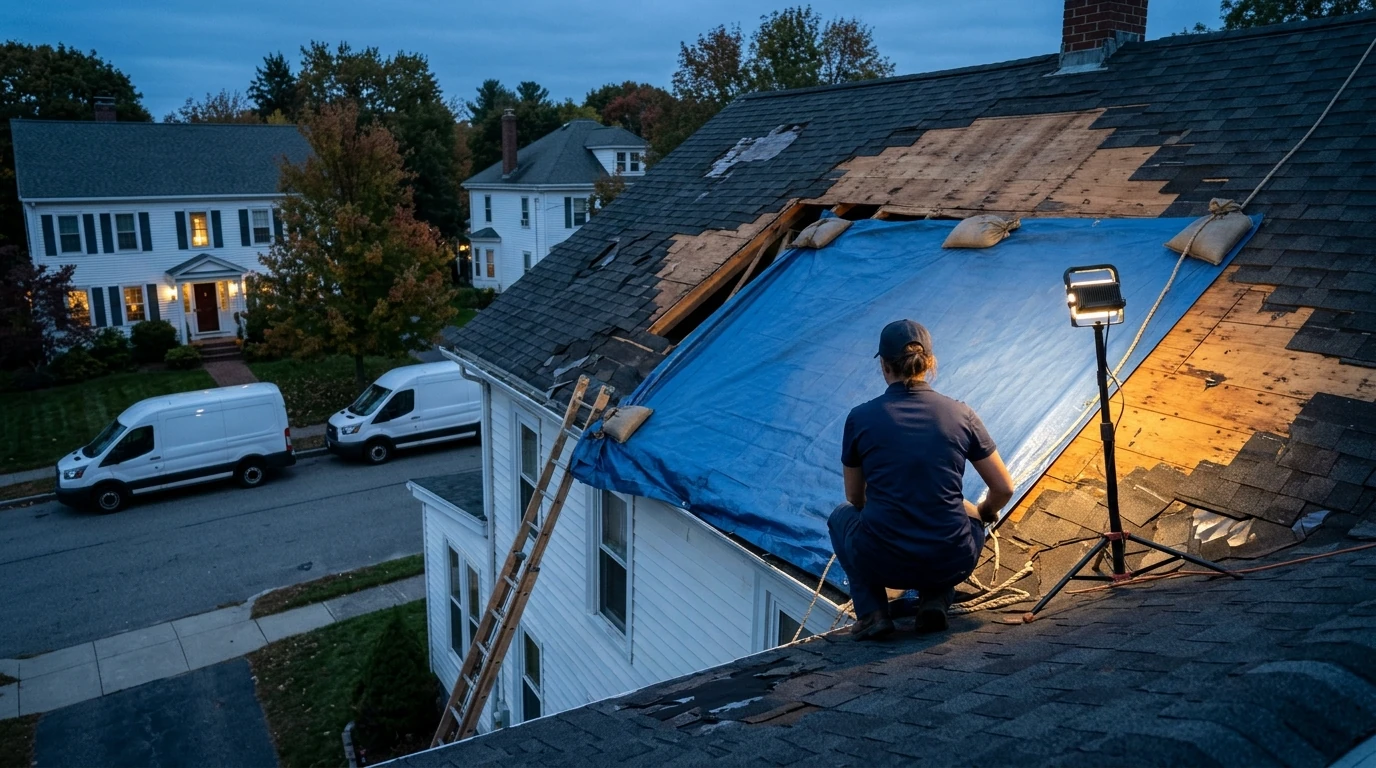
Emergency roof tarping or board-up typically costs $300 to $1,500, depending on the size of the opening, the roof pitch, and whether the crew is working at height after dark. A standard residential roof tarp covering one section usually falls in the $400 to $900 range; a broken window or door boarded with plywood is closer to $150 to $400 per opening.
This is the step that happens before anything else. The goal is simple: stop more water or wind from getting into the structure. A tarp installed within hours of a storm, strapped and sealed at the edges rather than just thrown over the hole, is what keeps a $2,000 roof patch from turning into a $10,000 ceiling and insulation job. Most insurers expect this step and will reimburse it as part of the claim, since it falls under your duty to mitigate further loss.
How much do tree removal and roof repair cost together?
Tree removal from a structure plus the roof repair that follows typically runs $3,000 to $15,000 or more, and it’s usually billed as two separate line items: an arborist or tree service for the removal, and a roofer or general contractor for the structural repair. Larger trees, or ones leaning into power lines, push toward the higher end before any roof work even starts.
The order matters. Removing the tree safely, often with a crane or rigging if it’s resting on the roofline, has to happen before anyone can assess what’s underneath. Only then can a roofer confirm whether the damage is cosmetic (a few courses of shingle) or structural (cracked rafters, a compromised ridge beam). Insurance adjusters will usually want to see both the tree removal invoice and the roofer’s scope before settling the claim, so keep both documented separately.
What does water extraction cost after storm damage gets inside?
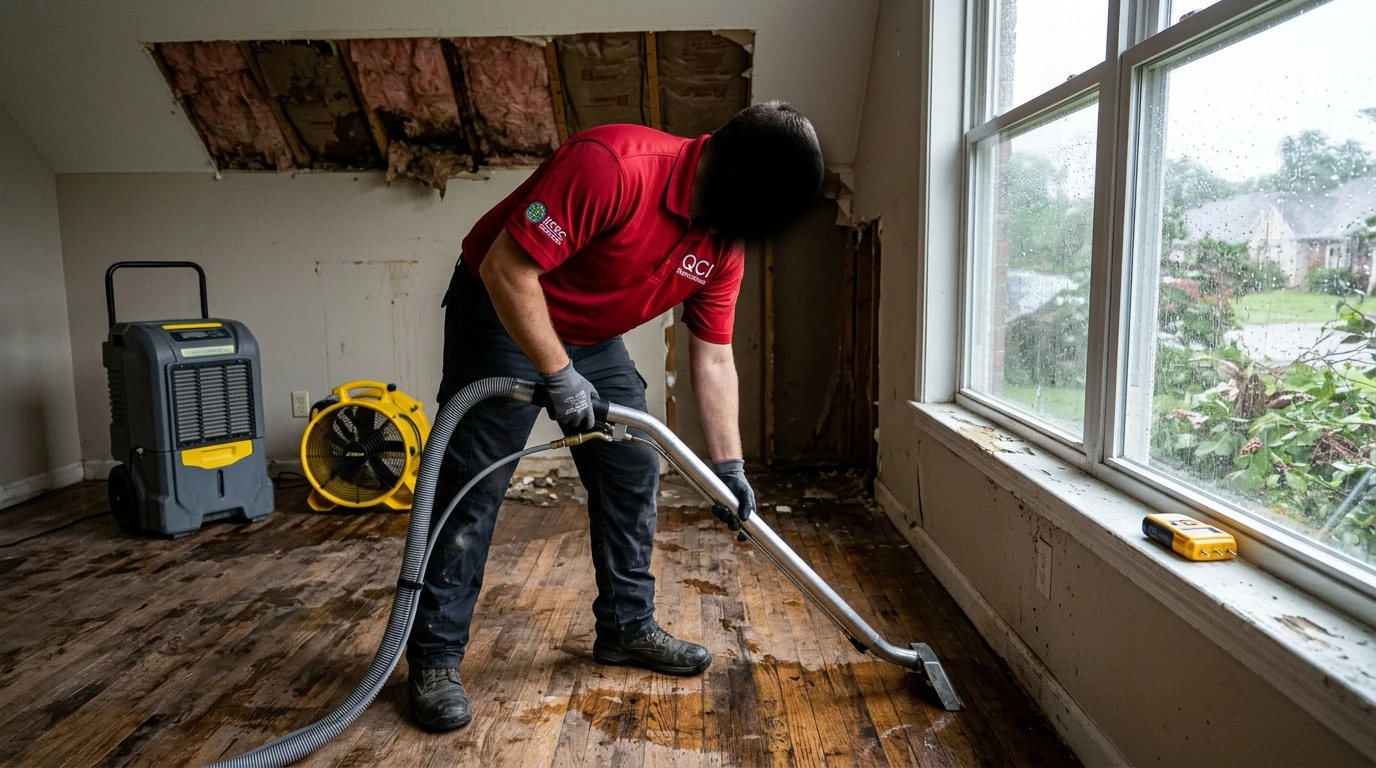
Water extraction and structural drying after storm intrusion typically costs $1,500 to $4,500 for a single affected area, using truck-mounted extraction, air movers, and dehumidifiers run over several days. Rain coming through a roof breach generally starts as Category 1 clean water, but it degrades the longer it sits against drywall, insulation, and framing, so speed matters more than people expect.
Wind-driven rain from a tropical storm or a hurricane remnant, or surface water that floods in at grade, is treated differently; that’s Category 3 water under the ANSI/IICRC S500 standard, and it calls for more aggressive material removal and antimicrobial treatment. A crew should document moisture readings room by room, both for the drying plan and for the insurance file. If you’re not sure which category applies to your situation, our guide on the first 24 hours after water damage walks through what to check before a crew arrives.
What will homeowners insurance pay for storm damage, and what’s the one-third upfront rule?
Most standard homeowners policies cover sudden, storm-caused damage from wind, hail, and a tree falling on the house, but they exclude flood water that rises from outside, which needs a separate flood policy. According to the Insurance Information Institute, wind and hail are among the most commonly covered perils, while surface flooding is almost always excluded from a standard policy.
That split matters for storm claims specifically, because a single event can produce both: wind tears off shingles (covered), and then water that pools in the yard seeps through the foundation (not covered without a flood policy). Document both separately with photos, and ask your adjuster to note which category each line item falls under.
On the contractor side, Massachusetts law limits how much a contractor can collect before work starts. Under the state’s Home Improvement Contractor Program, a contractor generally cannot require a deposit larger than one-third of the total contract price (or the cost of custom materials, if that’s less) before work begins. Any contractor asking for half or more upfront on a storm rebuild is outside that rule, and that’s worth asking about before you sign anything.
Who should you call first for storm damage repair in Auburn?
Call for emergency tarping or board-up first, same day if you can, before worrying about contractors for the rebuild. Stopping the water is what protects the rest of the claim and keeps a roof problem from becoming a ceiling, insulation, and drywall problem.
From there, most homeowners end up coordinating three or four separate companies: a tarping crew, a water mitigation company, a roofer, a general contractor for the interior rebuild, and sometimes a tree service. QCI Restoration runs all of that under one roof on a “One Call Does It All” model, meaning the same company that tarps the roof on day one can also handle the drying, the roof replacement, and the interior rebuild, without you managing separate schedules and separate invoices. For more on what to check before hiring anyone for storm work, see our guide to choosing a restoration company, and for a breakdown of who to call in what order, this post covers it in more detail.
A real cost for your house starts with a written scope, not a phone estimate. If a storm has left your roof open or water sitting in a room, get the stabilization done first, then ask for a line-item breakdown before the rebuild starts.
About QCI Restoration
QCI Restoration is a 24/7 restoration and general contracting company based in Auburn, MA, serving Worcester County and the MetroWest region. Their crews handle storm damage restoration, emergency board-up and tarping, roofing, and full reconstruction, along with water, fire, mold, and biohazard services, under one contract so homeowners aren’t coordinating multiple companies after a loss.
Need help now? Call QCI Restoration at (508) 756-8800.
Video Transcript
A tree came down on your roofline during the last storm, and you’re staring at exposed sheathing, wondering what repairs actually cost. Storm damage repair breaks into three phases: stopping the damage today, drying out anything wet, and the full rebuild. Emergency roof tarping or window board-up usually runs three hundred to fifteen hundred dollars, done fast to stop further damage. If wind-driven rain got inside, water extraction and structural drying typically adds fifteen hundred to forty-five hundred dollars. A fallen tree means two separate costs: removal by an arborist, then roof repair, together running three thousand to fifteen thousand dollars or more. Full rebuilds, covering roofing, siding, or interior drywall, range from a few thousand dollars to twenty thousand or higher. Good news: most homeowners policies cover sudden wind and hail damage, though rising flood water needs separate coverage. Massachusetts law protects you too; contractors can’t collect more than one-third of the total price upfront. Every home is different, roof pitch, material, and layers all matter, so a written, room-by-room scope gives you the real number. Don’t wait for small damage to become a big bill. Call QCI Restoration at (508) 756-8800 for a free estimate.