
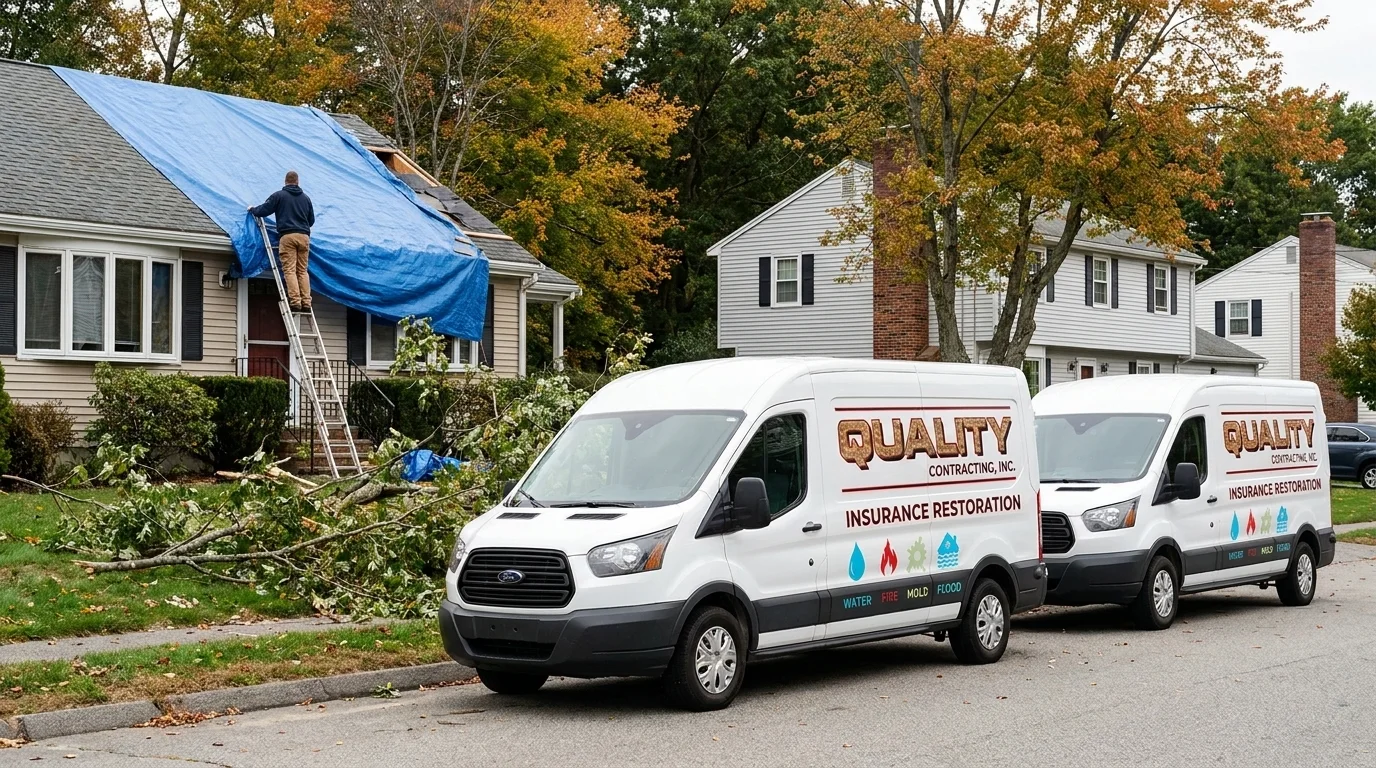
Storm Damage Restoration in Auburn
Storm damage restoration in Auburn and surrounding areas. Insurance billing accepted. Call (508) 756-8800.
A storm doesn’t give you a warning before it drops a 60-foot oak through your roof. One hour you have a house; the next you have a tarp situation, a soaked attic, and a clock ticking toward mold colonization. Storm damage is uniquely complicated because it rarely comes as a single problem, it arrives as wind damage, water intrusion, structural compromise, and debris impact all at once, each one compounding the others if the response is slow or incomplete.
What Storm Damage Restoration actually involves
Storm damage restoration is not the same as a repair call. It’s a sequenced response that has to address immediate structural exposure, water infiltration, and debris hazards before any permanent repairs can begin.
After a significant storm, whether a nor’easter rolling through central Massachusetts, a fast-moving tornado-strength microburst, or a hurricane remnant that stalls over Worcester County, the visible damage is rarely the whole story. A tree limb through a dormer exposes the roof deck to rain for hours before anyone arrives. That water travels down rafters, saturates insulation, and pools on ceiling drywall. Siding blown off a wall lets wind-driven rain wick into wall cavities. Gutters torn free leave fascia boards soaked and unprotected.
The work involves emergency tarping and board-up to stop ongoing exposure, controlled debris removal to safely access damaged areas, moisture mapping with thermal imaging and pin-type meters to find hidden water, and then a drying and structural assessment phase before reconstruction begins. Depending on the storm type and the age of the home, much of Auburn and the surrounding towns carry housing stock from the 1940s through the 1970s, that assessment may also need to account for lead paint or older roofing materials disturbed by impact.
Our process
-
Emergency stabilization, Tarping compromised roof sections, boarding broken windows and doors, and securing any structural elements at immediate risk of further collapse or water entry. This step happens before anything else, because every hour of open exposure adds to the loss.
-
Damage mapping and documentation, A systematic walk of the exterior and interior using moisture meters, thermal imaging, and photo documentation. This isn’t just for the repair scope, it’s the evidence package your insurance adjuster needs to process the claim accurately. Hidden moisture behind intact drywall is one of the most commonly missed items in a storm claim.
-
Debris and hazard removal, Tree limbs, shattered glass, torn roofing material, and downed sections of siding are removed in a controlled sequence. Larger tree removal that requires rigging or crane work is coordinated with qualified arborists before structural repairs begin.
-
Water extraction and structural drying, Any water that entered the structure is extracted and the affected assemblies are dried using commercial air movers and dehumidifiers. Moisture readings are logged daily. Drying a storm-soaked wall cavity or attic assembly typically takes three to five days under active drying conditions, cutting that process short is how secondary mold problems start.
-
Reconstruction and restoration, Once the structure is dry and stable, permanent repairs begin: roofing, siding, windows, framing, insulation, drywall, and finish work. A written scope of work is produced before any reconstruction starts so the homeowner and insurance carrier have a clear, itemized picture of what’s being done and why.
What separates a good storm damage response from a bad one
The most common failure in storm damage restoration is treating it like a roofing job. A roofer can patch the penetration, but if no one mapped the moisture that entered during the six hours between the storm and the repair, wet insulation and damp framing get sealed back inside the building envelope. Within two to three weeks, that’s a mold problem.
Insurance adjusters look for documentation that proves the full scope of loss, not just the visible impact point. Photos of the damage alone aren’t enough. A thorough claim includes moisture readings with GPS-tagged locations, thermal images showing water migration patterns, and a written narrative that connects the storm event to every affected material. Adjusters are trained to question claims that lack this chain of evidence, and underdocumented claims frequently result in partial payments that leave homeowners covering the gap.
Another common gap: failing to identify secondary structural damage. A tree impact that appears to have only damaged shingles can transfer load forces into ridge boards, rafters, or wall framing. That kind of damage doesn’t show up until a contractor pulls back the first layer of material, and if it wasn’t in the original scope, the supplement process with insurance can add weeks to the timeline.
What does Storm Damage Restoration cost?
Cost depends on the documented scope of loss. What was hit, how many systems were affected, and how long the structure stayed open to the weather all shape the scope. We produce a line-item scope with photos and moisture readings formatted for insurance carriers. For insured losses we bill the carrier directly. Homeowners insurance typically covers sudden storm damage to the structure, wind, hail, fallen trees, though flood-origin damage usually requires a separate flood policy.
Seasonal and regional considerations
Central Massachusetts sees storm damage year-round, but the risk profile shifts by season. Late summer and fall bring the remnants of Atlantic hurricanes and tropical storms that can dump several inches of rain in a few hours. Winter nor’easters combine heavy wet snow loads with ice damming, a condition where ice builds at the roof edge and forces meltwater back under shingles and into wall assemblies. Spring brings rapid snowmelt and severe thunderstorm lines capable of producing straight-line winds that rival tornado-strength gusts.
Older homes in Auburn, Worcester, and the surrounding towns often have roof pitches and gutter configurations that weren’t designed for the ice dam conditions central Massachusetts now sees regularly. If your home has had ice dam leaks in past winters, that history is relevant information when scoping a storm damage claim, prior water intrusion can mean existing moisture damage that a new storm event reactivates.
Service area
Quality Contracting, Inc. is based in Auburn, MA and serves homeowners, property managers, and commercial building owners across Southern New England, with crews responding across a 50 mile radius of Auburn, including Worcester, Shrewsbury, Westborough, Southborough, Hopkinton, Framingham, Natick, Wellesley, Needham, Newton, and Weston. Individual service-area pages cover storm damage restoration details specific to each community.
If a recent storm left your roof open, your siding compromised, or water somewhere it shouldn’t be, the next step is a damage assessment, not a sales call. Call Quality Contracting, Inc. at (508) 756-8800 to schedule your storm damage assessment and get a written scope before any work begins.
Frequently Asked Questions
Does homeowners insurance cover storm damage restoration?
My roof was damaged but it's not actively leaking inside. Do I still need emergency tarping?
How do you find water damage that isn't visible after a storm?
A tree hit my house. When is it safe to go back inside?
What's the difference between hurricane damage cleanup and tornado damage cleanup, and does it change how you respond?
Looking for the best storm damage restoration company in Auburn?
Quality Contracting, Inc. provides storm damage restoration in Auburn, MA and the surrounding area. Customers rate us 4.6 out of 5 stars across 108 Google reviews. We answer calls 24/7 — call (508) 756-8800 for immediate help.
Need Storm Damage Restoration now?
We respond 24/7 across Auburn and surrounding MA cities.