Water Damage Restoration in Auburn
Water damage restoration in Auburn and surrounding areas. Insurance billing accepted. Call (508) 756-8800.
You noticed the ceiling stain this morning. By afternoon, the drywall was soft to the touch. By evening, you could hear water moving somewhere inside the wall. That gap, the hours between when water enters a structure and when drying equipment is running, is where most of the real damage happens. Wet framing, saturated insulation, and soaked subfloor don’t announce themselves; they quietly set the conditions for mold colonization, which can begin in as little as 24 to 48 hours after a moisture event.
What Water Damage Restoration actually involves
Water damage restoration is not mopping up and running a fan. It’s a sequenced technical process, water extraction, controlled structural drying, moisture monitoring, and in some cases containment, designed to return a structure to its pre-loss moisture content without tearing out more material than necessary.
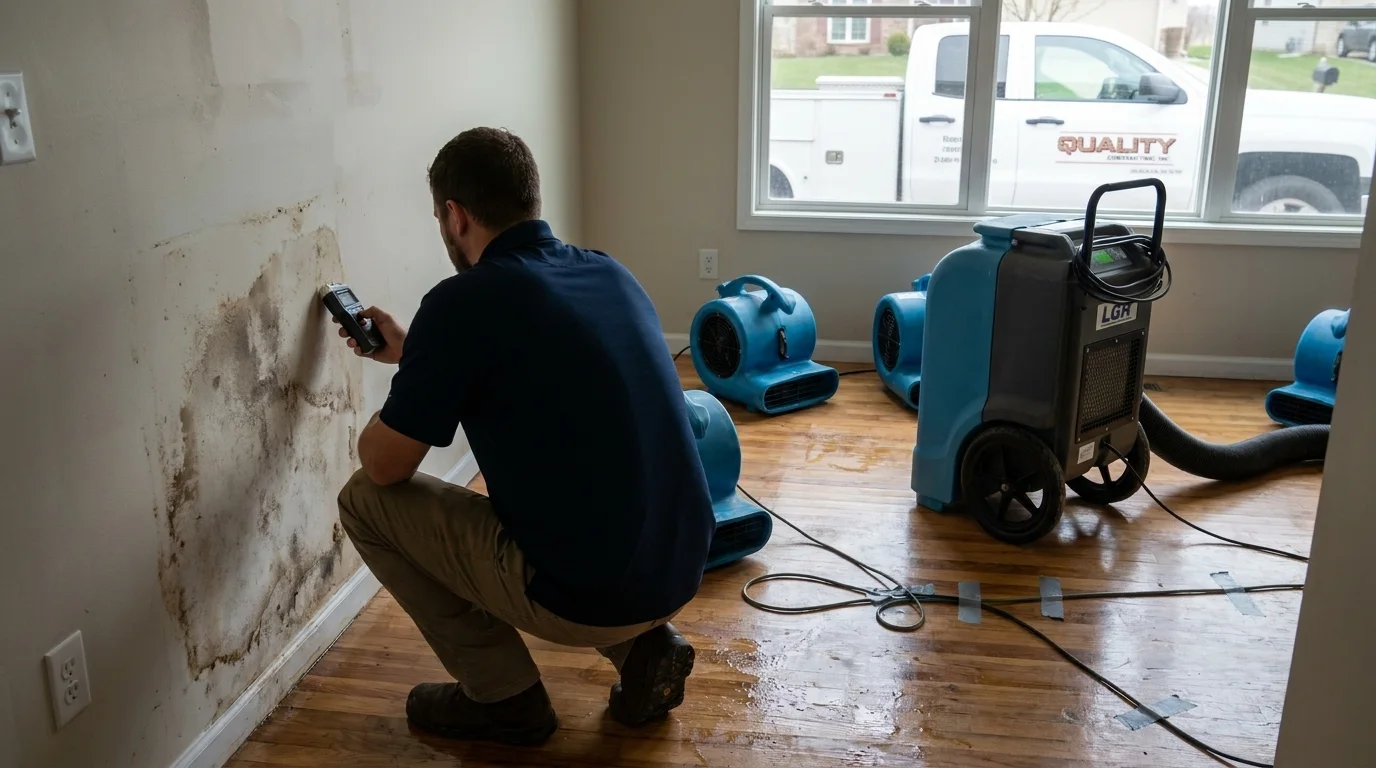
The equipment matters. Truck-mounted or portable extractors pull standing water from carpet, padding, and hard flooring before it migrates further into subfloor assemblies. Industrial low-grain refrigerant (LGR) dehumidifiers then pull moisture vapor out of the air and out of building materials at a rate that a hardware-store dehumidifier simply cannot match. Axial and centrifugal air movers direct that drying airflow into wall cavities, under cabinetry, and across concrete slabs. Thermal imaging cameras and penetrating moisture meters track what the eye can’t see, moisture trapped inside wall assemblies, beneath tile, or inside ceiling joists.
Timeline depends on water category and affected materials. A clean-water pipe burst in a single room with no affected hardwood can often be dried in three to five days. A Category 2 loss (dishwasher overflow, washing machine backup) involving subfloor and wall cavities typically runs five to seven days. Category 3 water, sewage, floodwater, or any water that has been standing long enough to become contaminated, requires additional containment, antimicrobial treatment, and in many cases selective demolition of porous materials that cannot be safely dried in place.
Our process
-
Inspection and moisture mapping. Before any equipment is placed, affected areas are documented with moisture meters and thermal imaging. This establishes a baseline and identifies hidden moisture pockets that would otherwise be missed, and left to cause secondary damage.
-
Water extraction. Standing water is removed using truck-mounted or portable extraction equipment. Carpet and pad are evaluated: pad almost always requires removal because it retains water and cannot be dried effectively in place. Hardwood floors are assessed for cupping and moisture content to determine whether drying in place is viable.
-
Structural drying and containment (if required). LGR dehumidifiers and air movers are positioned per drying calculations based on the affected square footage, material types, and ambient conditions. For Category 2 or Category 3 losses, affected zones are contained to prevent cross-contamination, and antimicrobial agents are applied to exposed structural materials.
-
Daily moisture monitoring. Drying is not set-and-forget. Moisture readings are logged daily across all monitoring points. Equipment is adjusted, repositioned, added, or removed, based on actual drying progress rather than a fixed schedule. This documentation becomes part of the claim file.
-
Clearance and scope for repairs. Once materials reach target moisture content, drying equipment is removed and a final moisture report is generated. At that point, a repair scope can be written for any materials that were removed or damaged, drywall, flooring, insulation, cabinetry, so reconstruction can begin with dry, stable substrates.
What separates a good water damage response from a bad one
The most common failure point is incomplete extraction followed by under-powered drying. A single residential dehumidifier in a 400-square-foot basement does not constitute structural drying. Experienced adjusters know this, and so do the mold remediation contractors who get called six weeks later.
A second common mistake is skipping moisture mapping on adjacent materials. Water follows the path of least resistance, it travels along wall plates, wicks up drywall paper, and pools inside floor assemblies well beyond the visible wet area. Treating only what’s visibly wet leaves hidden moisture that won’t show up until it grows something.
For Category 2 and Category 3 losses, proper containment and antimicrobial treatment are not optional steps, they’re the difference between a restorable structure and one that requires significantly more demolition. Insurance adjusters on larger losses will look for a drying log with daily moisture readings, a clear water category classification, and documentation of any containment measures taken.
What does Water Damage Restoration cost?
Cost depends on the documented scope of loss. Water category, affected square footage, materials involved, and how quickly mitigation begins all affect what the scope includes. We produce a line-item scope with photos and moisture readings formatted for insurance carriers. For insured losses we bill the carrier directly. Standard homeowners insurance typically covers sudden and accidental water damage, a burst pipe, appliance failure, or roof leak, but generally excludes gradual leaks and ground-level flooding, which requires separate flood insurance.
Seasonal and regional considerations
Central Massachusetts has a specific water damage calendar. Freeze-thaw cycles from January through March are the leading cause of pipe bursts in the region, older homes in Auburn and Worcester with uninsulated exterior walls or pipes running through unconditioned garage spaces are especially vulnerable. Ice damming along rooflines is a separate but related problem: meltwater backs up under shingles and enters wall and ceiling assemblies, often without any visible exterior sign until the interior is already saturated.
Spring snowmelt and heavy April rains push groundwater against foundation walls throughout Worcester County, making sump pump failures and basement seepage a recurring issue from March through May. Summer brings its own risk, humid air conditioning systems, condensate line backups, and the occasional severe storm. Knowing the regional pattern helps set realistic expectations for scheduling and drying times, since high ambient humidity in summer slows structural drying and may require additional dehumidification capacity.
Service area
Quality Contracting, Inc. is based in Auburn, MA and serves communities across Southern New England, with crews responding across a 50 mile radius of Auburn, including Worcester, Shrewsbury, Westborough, Southborough, Hopkinton, Framingham, Natick, Wellesley, Needham, Newton, and Weston. The city-specific pages for each community link back here for a full description of the water damage restoration process.
If you’re looking at wet walls, soft flooring, or a moisture reading that won’t come down, the next step is a thorough moisture assessment, not a guess. Call Quality Contracting, Inc. at (508) 756-8800 to schedule your moisture assessment and get a written scope before any work begins.
Frequently Asked Questions
Does homeowners insurance cover water damage restoration?
How long does structural drying typically take, and what affects the timeline?
What's the difference between Category 1, 2, and 3 water damage, and why does it matter for cleanup?
Can hardwood floors be dried in place, or do they always need to come up?
What should I do — and not do — while waiting for the restoration crew to arrive?
Looking for the best water damage restoration company in Auburn?
Quality Contracting, Inc. provides water damage restoration in Auburn, MA and the surrounding area. Customers rate us 4.6 out of 5 stars across 108 Google reviews. We answer calls 24/7 — call (508) 756-8800 for immediate help.
Need Water Damage Restoration now?
We respond 24/7 across Auburn and surrounding MA cities.