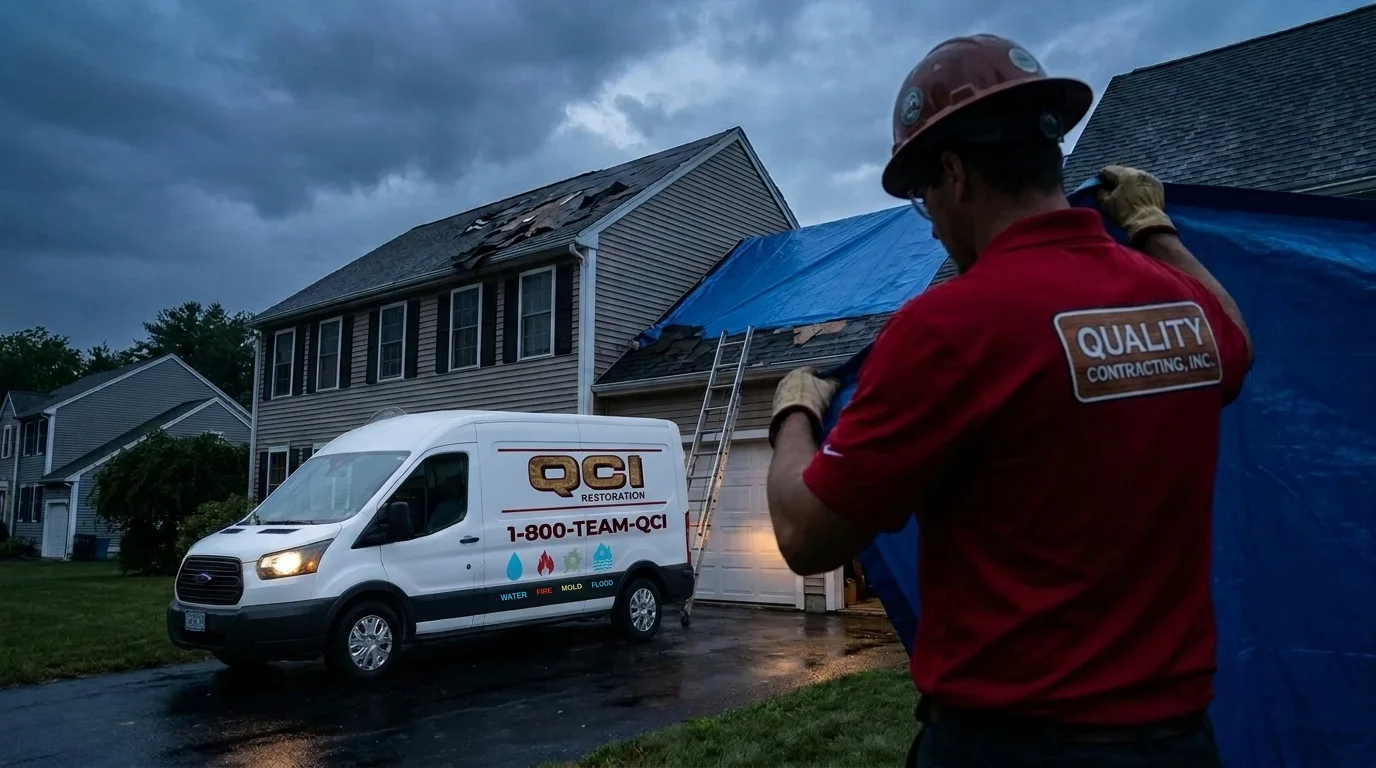
If a nor’easter just peeled shingles off your roof or a summer microburst dropped a tree limb through your siding in Auburn, MA, call QCI Restoration at (508) 756-8800. QCI answers 24/7, carries a 4.5-star Google rating across more than 120 local reviews, and handles storm damage cleanup, emergency tarping, roofing, and the full rebuild under one contract. That’s the “One Call Does It All” approach: one phone call covers mitigation, the roof, and the rebuild instead of you chasing down separate crews while water keeps finding its way inside.
But the order you make calls matters, especially in the middle of an active storm. Here’s the sequence that protects you, your house, and your insurance claim.
My Roof Is Leaking During the Storm, Who Do I Call First?
Check for immediate hazards before you call anyone, then call a storm restoration contractor to stop the water, not a roofer to schedule a repair for next week. A roofing company will often tell you to wait until it dries out. A storm damage crew tarps the active leak the same day.
If the storm is still going, stay away from windows and skylights and don’t go up on the roof. Rain blowing in through a damaged roof usually starts as clean water, but once it sits against drywall, insulation, and framing for more than a day it starts picking up contaminants from the building materials themselves. Interior buckets and towels buy you an hour, not a day.
Once the worst of the wind has passed and it’s safe to be outside, that’s when you call. In Worcester County, Shrewsbury and Westborough roofs see the same wind-driven rain and heavy wet snow load that Auburn does, so a tarp installed before the next band of weather arrives is what keeps a torn section of asphalt shingle from becoming a full ceiling collapse.
When Do You Call 911, the Utility Company, or a Plumber Instead?
Call 911 or your utility (National Grid or Eversource, depending on your street in Central Mass) immediately if you see a downed power line, a tree resting on a line, or smell gas; call a storm restoration contractor for everything else storm-related.
A downed line in standing water is a life-safety issue, not a property-damage issue. Don’t touch it, don’t drive over it, and keep pets and kids back until the utility confirms it’s de-energized. If you smell gas, leave the house and call from outside.
A plumber is the right call only when the leak is unrelated to the storm itself, like a supply line that happened to fail the same week. If the water is coming from the roof, a window, siding, or a foundation that took on runoff during the storm, that’s storm damage, and it’s handled by a restoration contractor who also coordinates the roofing and reconstruction side, not a plumber working alone.
What Happens When You Call for Storm Damage Help?
The first call is a short triage conversation: what’s damaged, is water actively entering, and is anyone on site. From there, a crew is dispatched to tarp the roof or board up a broken window or door, stopping further intrusion before anything else happens.
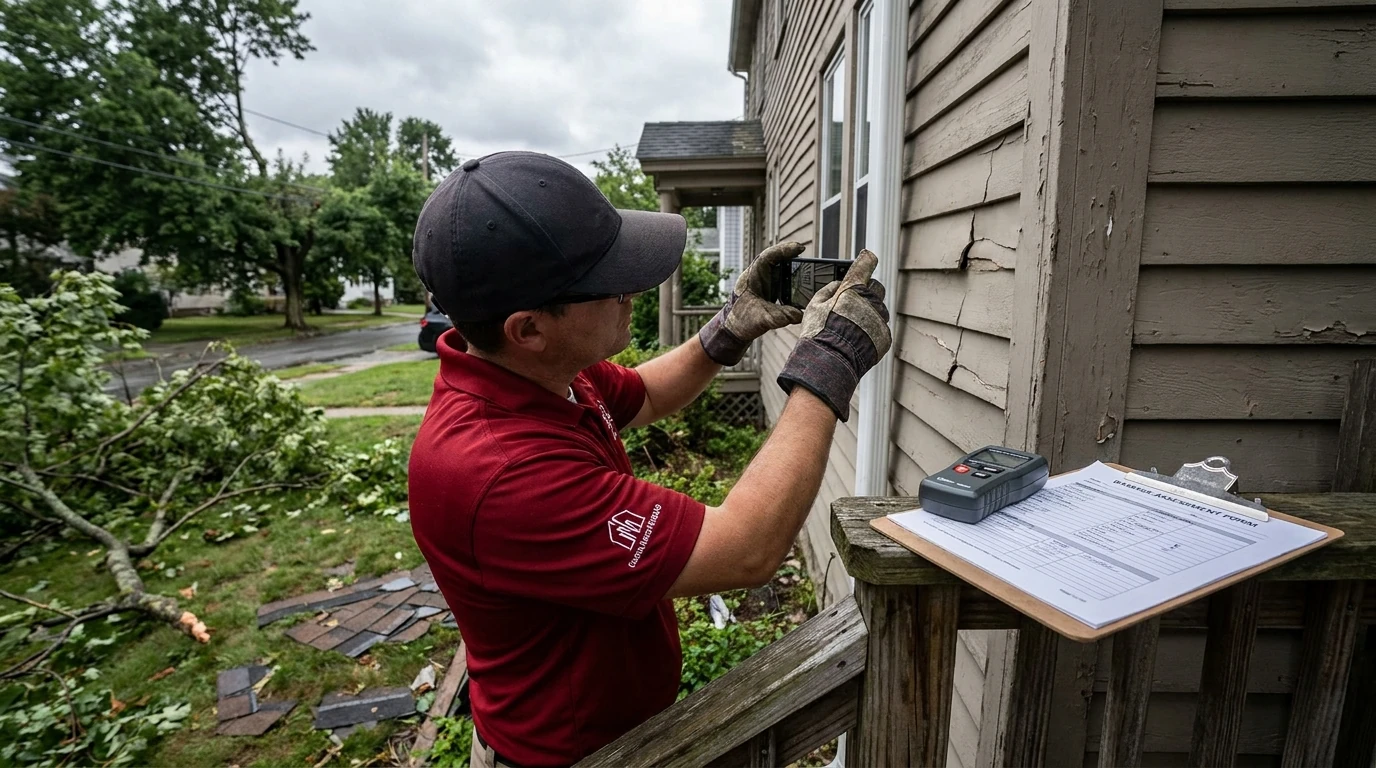
On site, the crew assesses the full extent of the damage, not just the obvious hole. Wind-driven rain during a nor’easter can push water under shingles and siding well past the visible break, so a thorough look often finds secondary damage you wouldn’t catch from the ground. Photos get taken at every stage, which matters for the next step.
Have your policy number, a rough description of when the damage happened, and your own phone photos ready if you have them. That paperwork moves the claim faster once you’re ready to call your insurer. A storm damage restoration visit typically covers emergency board-up and tarping first, with roofing and any needed reconstruction scoped out as separate, written phases once the structure is stable.
When Should You Call Your Insurance Company?
Call your insurer after the leak is stopped and the damage is documented, not before. Most standard homeowners policies cover sudden wind and storm damage to a roof as a named peril, but insurers generally want to see that you took reasonable steps to prevent further loss, which is exactly what the tarp and photos prove.
Wind, hail, and wind-driven rain intrusion are typically covered. Rising water from storm surge or an overflowing river is a different story: that’s flood damage, and it’s excluded from a standard homeowners policy unless you carry a separate flood policy. The Insurance Information Institute has a plain breakdown of which storm perils are and aren’t typically included.
Before any cleanup starts, take wide exterior photos of the whole roof or wall section, then close-ups of the specific damage, then interior shots of any staining or active dripping. Note the date and approximate time of the storm. Keep every receipt related to emergency tarping or board-up work, since most policies reimburse reasonable mitigation costs separately from the repair estimate.
If you’re still deciding who to hire for the repair and rebuild phase, our guide on choosing a restoration company in Auburn covers what to check before signing anything, including confirming a contractor’s registration through the state’s Home Improvement Contractor program.
A storm loss in Auburn rarely stays contained to just the roof. Wind-driven rain gets behind siding, soaks attic insulation, and sometimes brings a tree limb through a window all in the same event. Working with one contractor across the whole job keeps the tarp, the roof repair, and the interior rebuild on one schedule instead of three. Learn more about QCI Restoration.
About the Company
QCI is a 24/7 restoration and reconstruction contractor based in Auburn, MA, with a 4.5-star Google rating from more than 120 local reviews. Its crews cover storm damage cleanup, emergency board-up and tarping, roofing, water damage restoration, and full reconstruction, so one company can carry a storm loss from the first tarp to the final rebuild across Auburn, Worcester, Shrewsbury, Westborough, and the surrounding Central Mass towns.
Call now at (508) 756-8800 to get a crew tarping the active leak and starting the documentation your insurer will ask for.