Board-Up and Tarping in Auburn
Board-up and tarping in Auburn and surrounding areas. Insurance billing accepted. Call (508) 756-8800.
A broken window at 2 a.m., a roof torn open by a falling oak limb, a door frame blown out by fire department entry, the structure is exposed, and every hour it stays that way invites rain, wind, theft, and liability. Emergency board-up and tarping is the single fastest action you can take to stop a bad situation from compounding. It does not fix the damage; it freezes it in place so that everything that comes next, insurance documentation, structural drying, reconstruction, can happen on your terms instead of the weather’s.
What emergency board-up and tarping actually involves
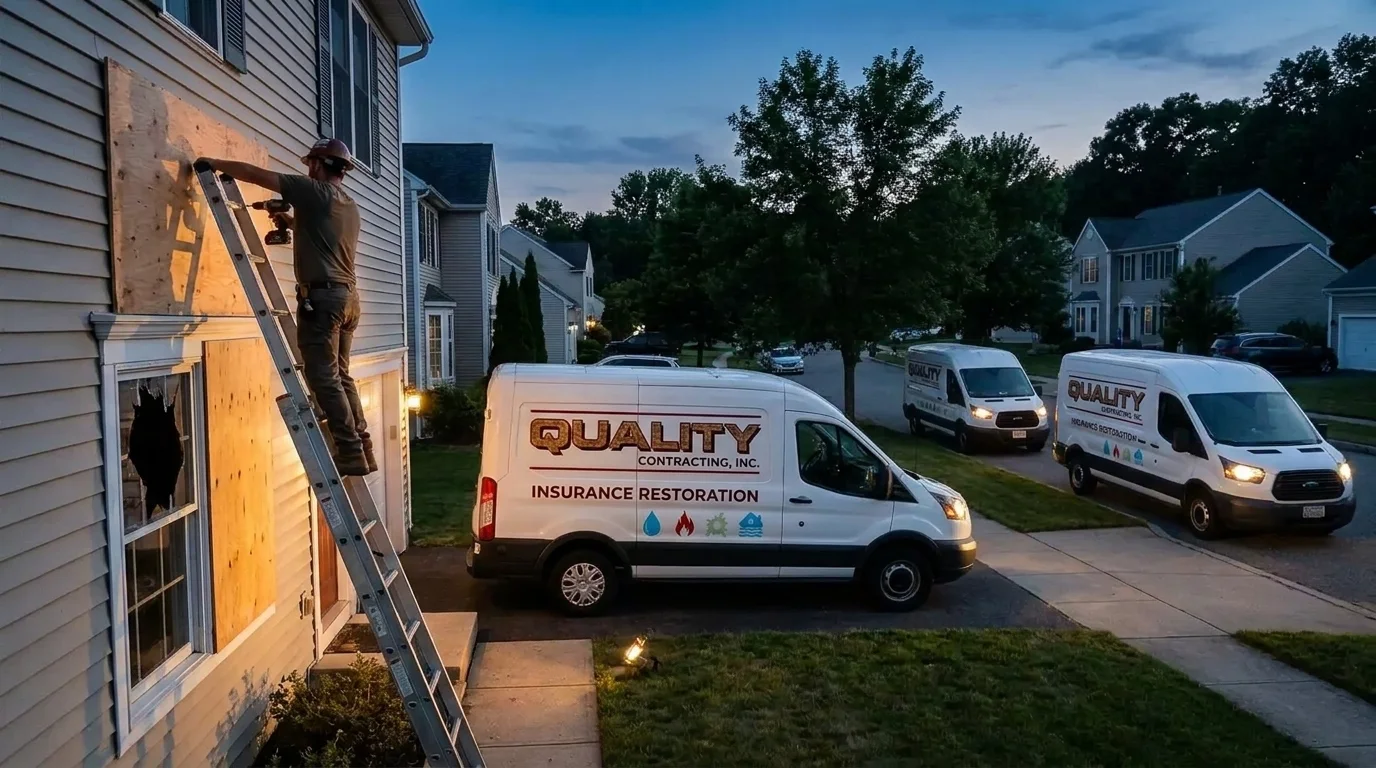
Board-up means installing plywood or polycarbonate panels over openings that no longer have a functioning barrier: broken windows, kicked-in doors, garage doors that won’t close, wall sections opened by impact or fire. Tarping means anchoring heavy-duty polyethylene sheeting, typically 6-mil or heavier, over damaged roof sections to redirect water away from the interior until permanent repairs can be scheduled.
The work is more technical than it looks. Panels need to be cut to fit and fastened in a way that won’t cause secondary damage to the frame or siding, insurance adjusters flag improper fastening as a separate line item. Roof tarps have to be weighted, capped, and tied at the ridge so wind can’t get underneath and peel them back. A tarp that fails overnight turns a contained loss into a flooded interior.
For most single-family homes, a board-up crew can secure the structure within two to four hours of arrival. Larger commercial properties or multi-point losses, a fire that blew out several windows and compromised the roof simultaneously, take longer and require more material staged on-site.
Our process
-
Site assessment and hazard check. Before any material goes up, the crew walks the perimeter and interior to identify structural instability, live utilities, or active fire department activity. No panel goes over an opening that still has smoke or heat behind it.
-
Measurement and material staging. Each opening is measured and plywood is cut to dimension on-site. Pre-cut panels that don’t fit flush leave gaps, gaps that let in water, animals, and unauthorized entry. Roof sections are measured for tarp coverage, accounting for overlap at the ridge and at least 18 inches past the damaged area on all sides.
-
Installation and fastening. Window and door panels are secured with structural screws into the frame, not the glass stop or trim. Roof tarps are anchored with cap nails and 2×4 battens along the edges; on steep pitches, ridge boards are used to prevent the tarp from sliding. Every fastener point is photographed before the crew leaves.
-
Photo documentation for insurance. Every opening, every panel, and every tarp section is photographed before and after installation. The documentation package, dimensions, materials used, fastening method, timestamps, is formatted for direct submission to your insurance carrier.
-
Handoff and next-step coordination. The crew walks the property owner or property manager through what was done, what the tarp or board-up is rated to handle (typical residential tarps are rated for 60–70 mph wind), and what conditions would require a return visit before permanent repairs begin.
What separates a good board-up response from a bad one
The most common failure point is tarp installation on a wet or icy roof. A crew that won’t use proper fall protection in those conditions either skips the roof entirely or installs a tarp that isn’t anchored correctly, and a loose tarp in a New England nor’easter is worse than no tarp, because it can peel roofing material off as it goes.
The second failure point is documentation. Insurance adjusters need to see that the board-up was a reasonable and necessary mitigation step, not an opportunity to run up costs. That means itemized materials, measured openings, and photos that show the pre-existing damage separately from the work performed. Carriers routinely reduce or deny board-up reimbursement when the documentation doesn’t support the scope.
A third issue is over-fastening into finished surfaces. Screwing through brick veneer, stucco, or composite trim to hang a panel creates new damage that wasn’t in the original loss. Experienced crews use frame-only fastening and, where that isn’t possible, document why an alternate method was used.
What does emergency board-up and tarping cost?
Cost depends on the documented scope of work, including the number of openings, roof square footage affected, and accessibility. We produce a line-item scope with photos and moisture readings formatted for insurance carriers. For insured losses we bill the carrier directly.
Seasonal and regional considerations
Central Massachusetts sees conditions that stress board-up and tarping work in ways that milder climates don’t. Ice dams in January and February can lift shingles and open roof decks overnight; a tarp installed without proper ridge anchoring will fail under the same ice load that caused the original damage. Summer convective storms, the fast-moving cells that drop large limbs with almost no warning, tend to cluster between June and September and often produce multiple calls in the same evening, which means response queues lengthen. If you’re in Auburn or the surrounding communities and a storm is in the forecast, securing an appointment before the system arrives is almost always faster than calling after.
Service area
Quality Contracting, Inc. is based in Auburn and serves property owners across Southern New England, with crews responding across a 50 mile radius of Auburn, including Worcester, Shrewsbury, Westborough, Southborough, Hopkinton, Framingham, Natick, Wellesley, Needham, Newton, and Weston. Individual service-area pages for each city link back to this page for full service details.
If your property has an opening that shouldn’t be there, a broken window, a damaged door, a roof section that’s exposed to the sky, call (508) 756-8800 to get a board-up crew scheduled and stop the loss from growing.
Frequently Asked Questions
Does homeowners insurance cover emergency board-up and tarping?
How long does a roof tarp actually hold up, and when does it need to be replaced?
What size plywood is used for window and door board-ups, and does it matter?
Can I board up my own windows after a fire or storm, or does it need to be a contractor?
What should I do while waiting for the board-up crew to arrive?
Looking for the best emergency board-up and tarping company in Auburn?
Quality Contracting, Inc. provides emergency board-up and tarping in Auburn, MA and the surrounding area. Customers rate us 4.6 out of 5 stars across 108 Google reviews. We answer calls 24/7 — call (508) 756-8800 for immediate help.
Need Emergency Board-Up and Tarping now?
We respond 24/7 across Auburn and surrounding MA cities.