Sewage Cleanup and Sanitization in Auburn
Sewage cleanup and sanitization in Auburn and surrounding areas. Insurance billing accepted. Call (508) 756-8800.
A backed-up sewer line doesn’t announce itself politely. One morning the toilet won’t flush, and by afternoon there’s an inch of gray-brown water spreading across the basement floor, carrying bacteria, viruses, and whatever the drain system has collected for years. Sewage is classified as Category 3 “black water” under industry standards, the most contaminated water type, and every hour it sits, it soaks deeper into concrete, drywall, and subfloor. The clock matters here in a way it simply doesn’t with a burst supply line.
What sewage cleanup and sanitization actually involves
Raw sewage backup is not a mop-and-bucket problem. The visible water is only part of it. Sewage carries fecal coliform bacteria, hepatitis A, norovirus, and in older New England homes, many of which were built before Auburn’s sewer infrastructure was modernized, it can also disturb lead paint and asbestos-containing materials in flooring or pipe insulation. A proper response addresses contaminated water, affected building materials, airborne pathogens, and odor-causing compounds all at once.
The work typically involves industrial-grade extraction equipment rated for contaminated water, followed by the controlled removal of porous materials (drywall, insulation, carpet, subfloor sections) that cannot be safely decontaminated. Hard surfaces, concrete, ceramic tile, PVC pipe, are treated with EPA-registered disinfectants and allowed to dwell for the contact time specified on the product label, not wiped off immediately. Air scrubbers with HEPA filtration run continuously during and after the work to capture aerosolized particles. The process from initial extraction to final clearance typically spans three to five days for a contained basement backup; larger losses or those involving finished living space take longer.
Our process
-
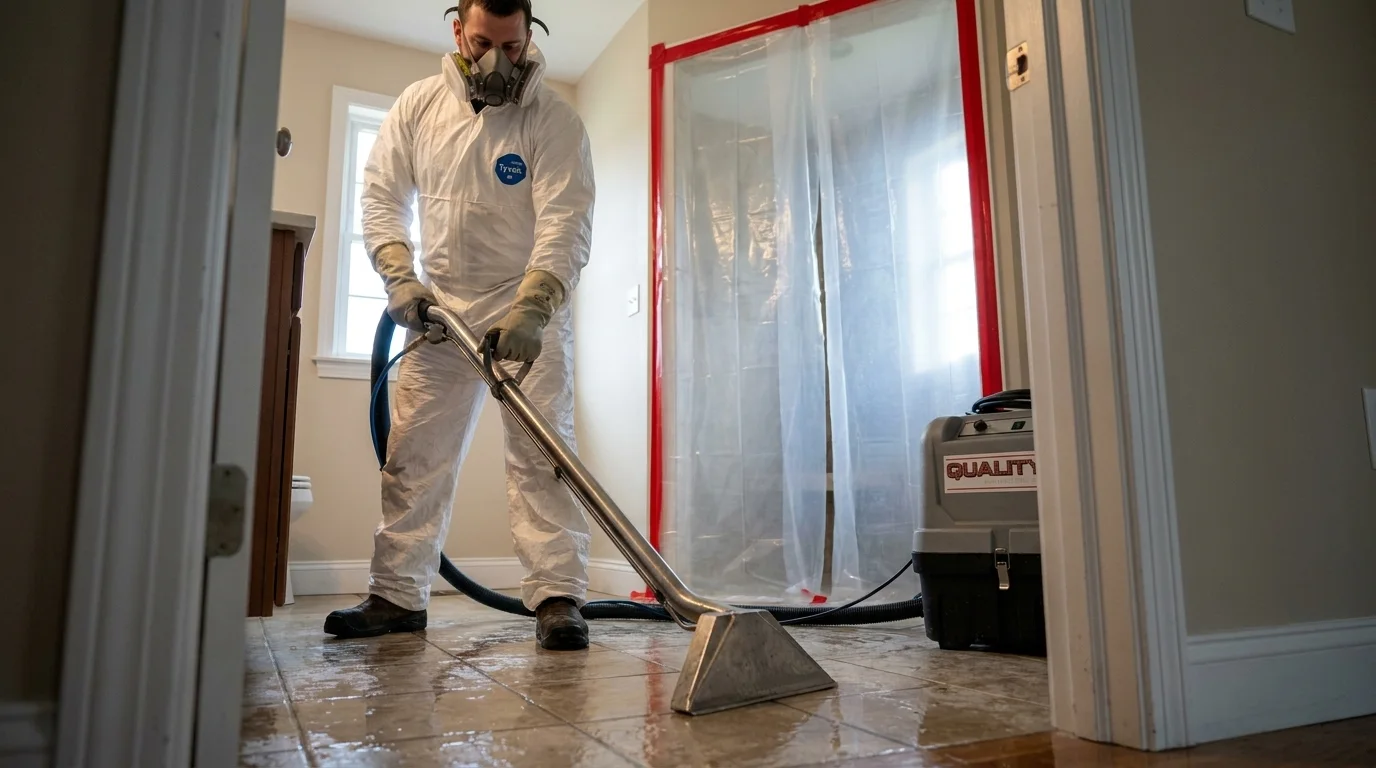
Containment and PPE staging. Before any material is moved, the affected area is isolated from the rest of the structure using physical barriers and negative air pressure where needed. Technicians work in full personal protective equipment, respirators, Tyvek suits, nitrile gloves, to prevent cross-contamination into clean areas of the home.
-
Contaminated water extraction and solid waste removal. Standing sewage is extracted using truck-mounted or portable units designed for Category 3 water. Solid waste is bagged, labeled, and disposed of according to applicable regulations. This step also includes removing any porous building materials, drywall, insulation, carpet padding, that absorbed sewage and cannot be restored.
-
Antimicrobial treatment and surface disinfection. All affected hard surfaces receive a two-stage treatment: a broad-spectrum antimicrobial applied at the correct dilution, followed by a hospital-grade disinfectant with documented dwell time. Particular attention goes to floor-wall junctions, subfloor seams, and any surface that held standing water, since pathogens concentrate where water pooled longest.
-
Structural drying and moisture verification. Once contaminated materials are removed and surfaces are disinfected, the drying phase begins using commercial dehumidifiers and air movers. Moisture readings are taken daily with calibrated meters at the wall cavity, subfloor, and slab level. Drying is not complete until readings return to pre-loss baselines, not just when surfaces feel dry to the touch.
-
Final inspection and odor control. Sewage odor is caused by hydrogen sulfide and ammonia compounds that penetrate porous surfaces. After structural drying, affected areas are treated for residual odor using hydroxyl generators or thermal fogging, depending on the materials involved. A final walkthrough documents conditions before reconstruction begins.
What separates a good sewage response from a bad one
The most common mistake in sewage cleanup is treating it like water damage from a clean source. Technicians who skip the containment step spread contamination into unaffected rooms on their boots and equipment. Drywall that “looks fine” above the waterline often has wicked contamination several inches higher than the visible tide line, cutting only to the visible line leaves active contamination inside the wall cavity.
Insurance adjusters look for documentation at every stage: photos of moisture readings, records of antimicrobial product names and dwell times, a written scope showing exactly which materials were removed and why. Without that paper trail, carriers have grounds to dispute the claim or reduce the payout. A thorough response also identifies the source of the backup, root intrusion, a failed ejector pump, a blocked municipal lateral, because remediating the damage without addressing the cause means the same loss happens again.
Older homes in the Auburn and Worcester area sometimes have clay or cast-iron lateral lines that are decades past their service life. A sewage backup in those homes is often a symptom of a larger plumbing failure, and the restoration scope needs to account for that possibility.
What does sewage cleanup and sanitization cost?
Cost depends on the documented scope of the loss. The volume of sewage, the size of the affected area, and how much finished material needs to be removed all affect the scope. We produce a line-item scope with photos and moisture readings formatted for insurance carriers. For insured losses we bill the carrier directly. Call us and we will walk you through the process for your specific situation.
Seasonal and regional considerations
In central Massachusetts, two seasonal patterns drive sewage backup calls. Spring snowmelt and heavy rain events in March through May saturate the ground and overwhelm municipal sewer laterals, pushing water back through floor drains and basement toilets. Late fall freeze events can crack aging clay laterals, causing partial collapses that back up without warning over the winter. Homes in Auburn and the surrounding Worcester County communities that were built before 1970 are disproportionately affected, the lateral lines in those neighborhoods are reaching the end of their engineered lifespan.
Service area
Quality Contracting, Inc. is based in Auburn, MA and serves communities across Southern New England, with crews responding across a 50 mile radius of Auburn, including Worcester, Shrewsbury, Westborough, Southborough, Hopkinton, Framingham, Natick, Wellesley, Needham, Newton, and Weston. The city-specific pages for each community link back here for full service details.
If you’re standing in a basement that smells like a sewer line, call (508) 756-8800 to speak with someone about beginning sewage removal and sanitization.
Frequently Asked Questions
Does homeowners insurance cover sewage backup cleanup?
Is sewage backup water more dangerous than a regular water leak, and why does that change the cleanup?
How far up the walls does sewage contamination actually travel?
What should I do — and not do — while waiting for the cleanup crew to arrive?
Can the sewage smell come back after cleanup, and what causes it?
Looking for the best sewage cleanup and sanitization company in Auburn?
Quality Contracting, Inc. provides sewage cleanup and sanitization in Auburn, MA and the surrounding area. Customers rate us 4.6 out of 5 stars across 108 Google reviews. We answer calls 24/7 — call (508) 756-8800 for immediate help.
Need Sewage Cleanup and Sanitization now?
We respond 24/7 across Auburn and surrounding MA cities.