
Crawl Space Encapsulation in Auburn
Crawl space encapsulation in Auburn and surrounding areas. Insurance billing accepted. Call (508) 756-8800.
The first sign is usually something you smell before you see it, a damp, earthy mustiness that drifts up through the floorboards and settles into the living space above. Then come the buckled hardwood floors, the doors that stick in summer, the unexplained spike in heating bills. Most of the time, the culprit is an open or poorly vented crawl space pulling humid ground air into your home’s structure. Encapsulation seals that system off entirely, replacing a perpetually damp dirt floor with a controlled, dry environment that protects framing, insulation, and air quality for decades.
What crawl space encapsulation actually involves
Encapsulation is not a coat of paint on a dirt floor. It is a complete moisture-control system that addresses every pathway ground moisture and outside air use to enter the crawl space.
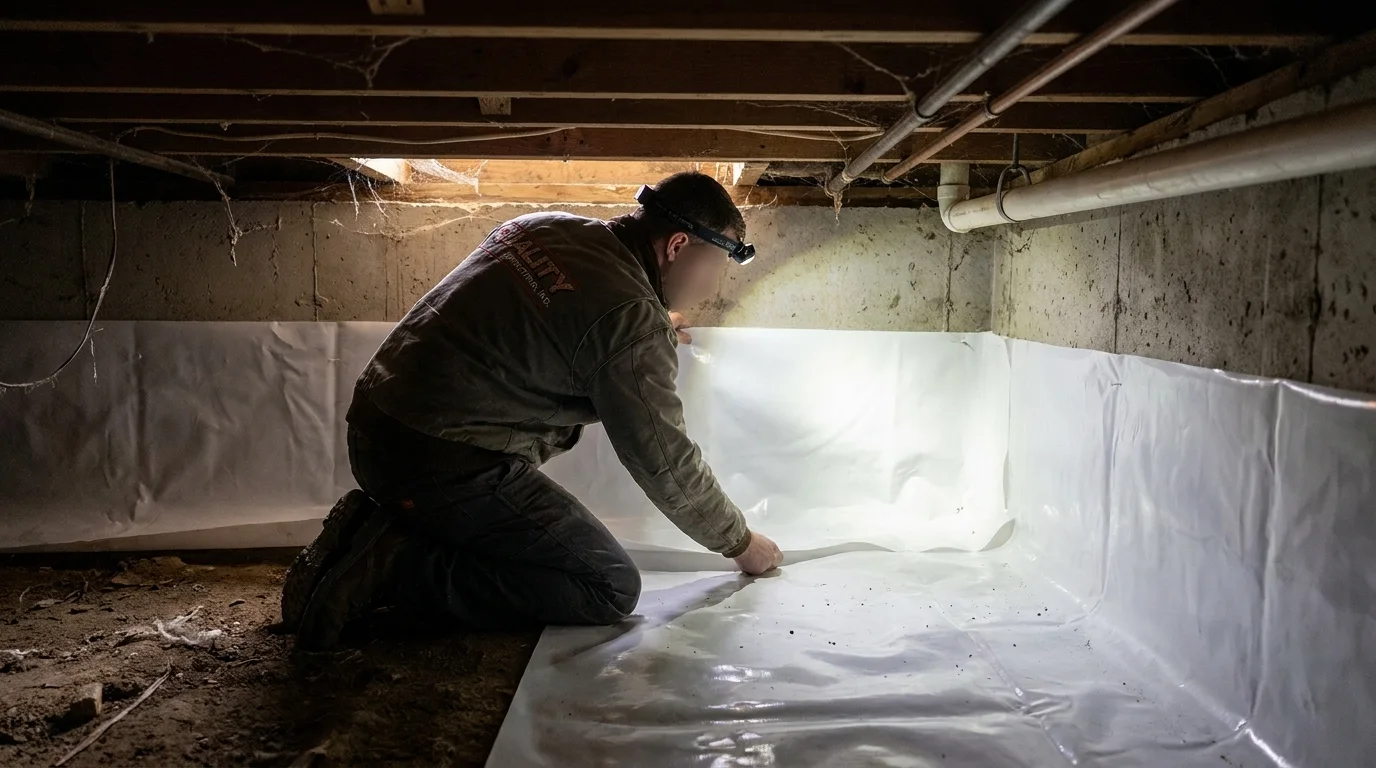
The core element is a reinforced polyethylene vapor barrier, typically 12 to 20 mil thick, that covers the entire crawl space floor and runs up the foundation walls, sealed at seams with specialized tape and mechanically fastened at the perimeter. Vents that once let outside air cycle through are sealed or blocked; in most New England crawl spaces, that ventilation strategy accelerates moisture problems rather than solving them because the humid summer air condenses the moment it hits cooler concrete and soil.
Depending on conditions, the system is completed with a crawl space dehumidifier sized to the cubic footage of the space, a condensate drain line, and sometimes a sump pit with a sealed cover if groundwater intrusion is present. Existing fiberglass batt insulation hanging between floor joists is almost always removed, it traps moisture against the wood, feeds mold, and loses R-value when wet. Rigid foam board is installed against the foundation walls instead, keeping the crawl space within the home’s thermal envelope.
A straightforward encapsulation in a typical 1,000–1,500 sq ft Auburn-area ranch or Cape takes one to two days. Larger homes, crawl spaces with standing water history, or spaces requiring significant debris removal and joist repair run three to four days.
Our process
-
Inspection and moisture mapping. Before any material goes in, the crawl space is measured, photographed, and assessed for existing moisture levels in the wood framing (using a pin-type moisture meter), visible mold growth, pest evidence, and drainage patterns. This determines liner thickness, dehumidifier sizing, and whether any remediation work needs to happen before encapsulation.
-
Prep and debris removal. Old, deteriorated insulation is bagged and removed. Any standing water is extracted. Debris, vapor barrier scraps from prior attempts, and organic material are cleared from the floor. If there is active mold on framing, that is addressed before the space is sealed, encapsulating over active mold locks the problem in.
-
Liner installation. The reinforced vapor barrier is rolled out across the floor with overlapping seams of at least 12 inches, taped with a compatible seam tape, and run up the foundation walls to a height of 6 to 12 inches above grade. Penetrations, pipes, columns, support posts, are wrapped and sealed individually. Vents are sealed from the interior.
-
Dehumidifier and drainage installation. A crawl space-rated dehumidifier (not a residential basement unit) is mounted or placed, ducted if necessary, and plumbed to a condensate drain or sump. If a sump pump is part of the scope, the pit is fitted with a sealed, airtight lid so it does not become a humidity source.
-
Final inspection and documentation. Moisture readings are taken again, the liner is inspected for gaps or unsealed penetrations, and the homeowner receives a walkthrough of the system, how to check the dehumidifier, what the normal operating range looks like, and what to watch for.
What separates a good encapsulation from a bad one
The most common failure point is liner thickness. A 6-mil poly sheeting, the kind sold at hardware stores, punctures easily during any future crawl space access and degrades within a few years. Proper encapsulation uses 12-mil minimum; 20-mil is standard in crawl spaces where any foot traffic is expected for HVAC or plumbing maintenance.
The second failure is sealing vents without addressing the moisture source. If groundwater is wicking through the foundation wall or the grading outside directs runoff toward the house, a sealed liner just traps that moisture inside a closed system. A thorough pre-installation inspection identifies these conditions before the liner goes down.
The third, and most consequential, mistake is encapsulating over existing mold. Once the space is sealed, conditions become stable enough that dormant mold can reactivate. Any visible mold on joists or sill plates needs to be remediated, and wood moisture content should be below 19% before the liner is installed.
Finally, dehumidifier sizing matters. A unit rated for 1,000 sq ft placed in a 2,200 sq ft crawl space will run continuously, burn out early, and never bring relative humidity below the 60% threshold where mold growth becomes a risk.
What does crawl space encapsulation cost?
Cost depends on the documented scope of work. Every job is different based on the size of the space, existing conditions, and what components the system requires. We produce a line-item scope with photos and moisture readings formatted for insurance carriers so the work is clearly supported from the start. For insured losses we bill the carrier directly. Quality Contracting, Inc. provides a written scope of work before any work begins so there are no surprises. Homeowners insurance typically does not cover encapsulation as a preventive upgrade, but it may cover related work, liner replacement, mold remediation, or structural drying, when the damage is tied to a covered sudden loss like a burst pipe or storm-driven water intrusion. Documentation of cause and scope is key to a successful claim.
Seasonal and regional considerations
In central Massachusetts, the window when crawl space moisture problems become most visible is late spring through early fall, the stretch when outdoor relative humidity climbs above 70% and unventilated crawl spaces trap that air against cooler soil and concrete. Auburn sits in a transition zone where freeze-thaw cycles from November through March can also drive frost heave and foundation seepage, meaning crawl spaces here face moisture pressure from two different directions across the year.
The practical implication: encapsulation scheduled in late spring often catches the worst of the problem early, but the work can be done year-round. Cold temperatures do not prevent liner installation; they simply require that any existing moisture in the framing be dried to an acceptable level before sealing.
Service area
Quality Contracting, Inc. is based in Auburn, MA and serves crawl space encapsulation customers across Southern New England, with crews responding across a 50 mile radius of Auburn, including Worcester, Shrewsbury, Westborough, Southborough, Hopkinton, Framingham, Natick, Wellesley, Needham, Newton, and Weston. Individual city and town service pages link back here for full process details.
If your floors feel soft, your energy bills have crept up without explanation, or you have noticed that smell, the one that is hard to describe but easy to recognize, call Quality Contracting, Inc. at (508) 756-8800 to schedule a crawl space assessment. The inspection will tell you exactly what the space needs before any commitment is made.
Frequently Asked Questions
Does homeowners insurance cover crawl space encapsulation?
What thickness of vapor barrier is actually necessary for a crawl space?
How do I know if my crawl space has mold before it gets encapsulated?
Will encapsulating the crawl space actually lower my energy bills?
How long does a properly installed crawl space encapsulation system last?
Looking for the best crawl space encapsulation company in Auburn?
Quality Contracting, Inc. provides crawl space encapsulation in Auburn, MA and the surrounding area. Customers rate us 4.6 out of 5 stars across 108 Google reviews. We answer calls 24/7 — call (508) 756-8800 for immediate help.
Need Crawl Space Encapsulation now?
We respond 24/7 across Auburn and surrounding MA cities.