Quality Contracting, Inc. logo
Carpet Cleaning in Auburn
Carpet Cleaning

Carpet Cleaning in Auburn

Carpet cleaning in Auburn and surrounding areas. Insurance billing accepted. Call (508) 756-8800.

That smell — somewhere between wet dog and old gym bag — usually hits a few days after a spill soaks through the carpet pile and into the backing. By then, surface blotting has long since stopped helping. Odor-causing bacteria and residual soil have migrated into the pad underneath, and a rental machine from the hardware store will only push moisture deeper. Professional carpet cleaning gets into the fiber structure and the backing layer where everyday vacuuming and spot-treating can’t reach, pulling out allergens, ground-in grit, and the organic residue that causes persistent odors.

What carpet cleaning actually involves

Carpet fibers trap more than visible dirt. Fine particulate — pollen, pet dander, skin cells, sand tracked in from outside — works its way past the surface pile and settles near the backing where foot traffic grinds it against the fiber repeatedly. Over time that abrasion degrades the fiber itself, which is why high-traffic areas dull and mat down even in homes that vacuum regularly.

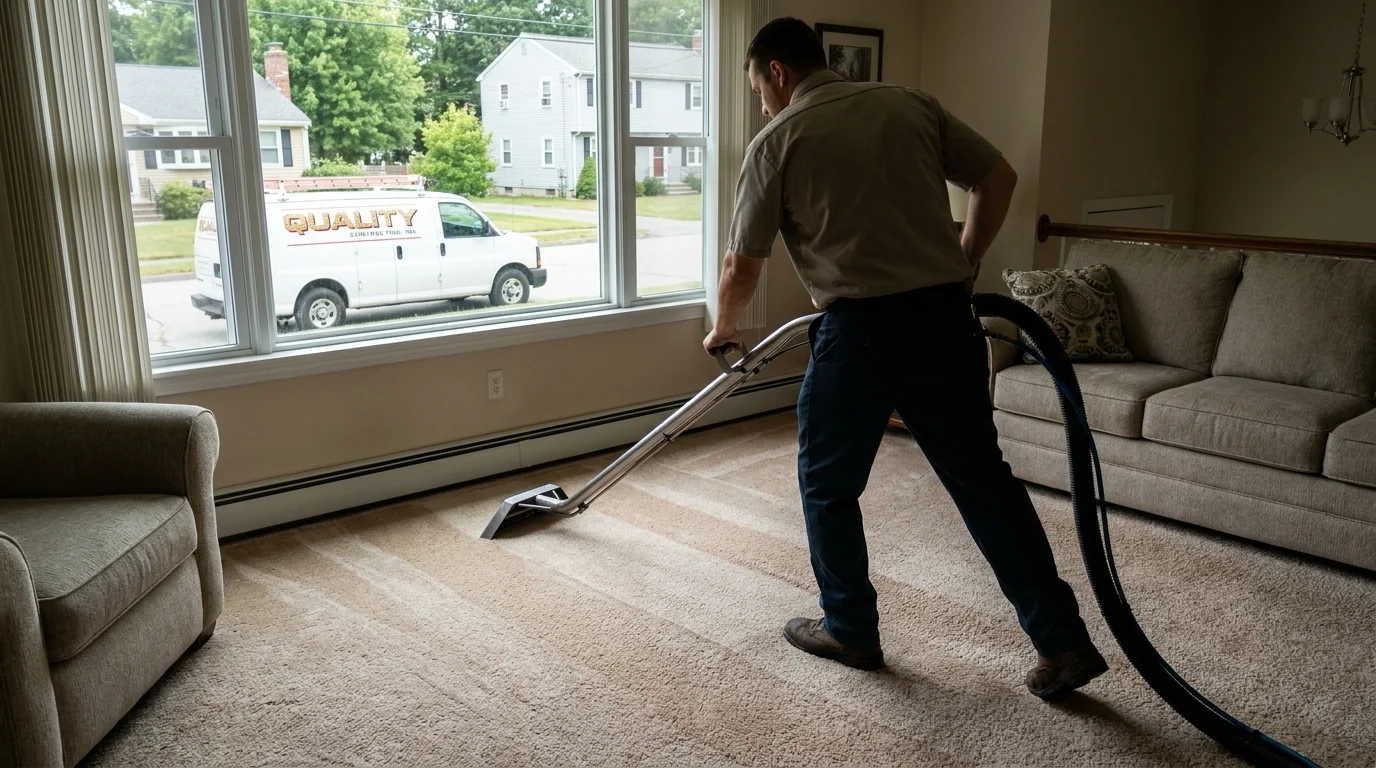
Professional deep carpet cleaning uses truck-mounted hot-water extraction equipment — the industry standard — which heats water to 200°F or higher and injects it into the pile under pressure while simultaneously vacuuming the loosened soil and water back out. The combination of heat, agitation, and near-immediate extraction is what separates professional carpet cleaning from consumer machines, which lack both the water temperature and the suction to remove what they put in. Dwell time with a pre-conditioner, fiber-appropriate agitation, and controlled drying time are all part of a complete cleaning. Typical drying time runs 4–8 hours depending on fiber type, humidity, and airflow in the space.

For commercial carpet cleaning in offices, retail spaces, and multi-family properties, the process is the same but scaled — high-traffic lanes often need a second pass, and scheduling around business hours matters.

Our process

  1. Pre-inspection and fiber identification. Not all carpet responds the same way. Wool, nylon, polyester, and olefin each have different pH tolerances and heat thresholds. Before any solution touches the floor, we identify the fiber type and construction (cut pile, loop, Berber) and check for existing damage, delamination, or areas where the backing has separated from the pad.

  2. Pre-treatment and dwell time. A pH-appropriate pre-conditioner is applied to the entire field and allowed to dwell — typically 5–10 minutes — to break the bond between soil particles and carpet fibers. Heavily soiled areas and high-traffic lanes get a targeted pre-spray. Carpet stain removal for set-in stains (coffee, wine, pet urine, grease) gets spot treatment with enzyme-based or oxidizing agents matched to the stain type before the main extraction pass.

  3. Hot-water extraction. Truck-mounted extraction equipment delivers heated water at high pressure through a cleaning wand worked in overlapping passes. The simultaneous vacuum pulls soil, solution, and the majority of moisture back out before it can saturate the pad. This step also handles carpet sanitization — the heat and cleaning agents reduce microbial load in the pile.

  4. Post-treatment and grooming. After extraction, a pH-neutralizing rinse prevents residue buildup that would otherwise accelerate re-soiling. The pile is groomed with a carpet rake to lift fibers back to their natural direction and promote even drying. In spaces with limited airflow, air movers are positioned to bring drying time down.

  5. Final walkthrough. We walk the space with the customer before we leave, pointing out any areas that may need a follow-up treatment and noting any pre-existing damage that was present before cleaning — important documentation if the cleaning is part of an insurance claim.

What separates a good carpet cleaning from a bad one

The most common mistake less-experienced operators make is over-wetting. When too much water is applied without sufficient extraction, it saturates the pad underneath. Wet pad is a mold and mildew incubator — within 24–48 hours in a humid space, microbial growth can begin in the backing layer, and the homeowner ends up with a worse odor problem than they started with. Proper extraction technique and equipment suction capacity are what prevent this.

A second common failure is using a one-size-fits-all cleaning solution. High-alkaline detergents left in wool or delicate fiber carpets cause irreversible browning and fiber damage. Skipping pH neutralization after extraction leaves a sticky residue that attracts soil rapidly — carpets cleaned this way look dirty again within weeks.

For insurance-related losses — water damage that soaked through carpet, smoke residue from a fire, or contamination from a sewage backup — documentation matters as much as the cleaning itself. Adjusters look for pre-cleaning moisture readings, photographic documentation of affected areas, and a written scope that distinguishes restorable carpet from carpet that needs replacement. Cutting corners on documentation can result in claim denials or disputes over what was present before work began.

What does carpet cleaning cost?

Typical costs depend on square footage, soil level, fiber type, and whether stain removal or sanitization treatments are needed. Most homeowners pay in the ranges below for professional carpet cleaning — these are industry-typical figures, not quotes.

ScenarioTypical range
Single room, light soiling$75 – $150
Whole home (3–4 bedrooms), moderate soiling$250 – $500
Heavy soiling or pet odor treatment$400 – $800
Commercial space (per 1,000 sq ft)$150 – $350
Carpet stain removal (per stain, set-in)$30 – $75
Post-water-damage carpet cleaning and sanitization$500 – $1,500+

Every job is different, and Quality Contracting, Inc. provides a written scope before work begins so there are no surprises. Standard carpet cleaning is generally not covered by homeowners insurance, but cleaning that is part of a documented water, fire, or sewage loss typically is — check your policy’s restoration language.

Seasonal and regional considerations

Auburn and the surrounding MetroWest and Central Massachusetts region run humid summers — relative humidity regularly sits above 60% from June through September. That matters for carpet cleaning because high ambient humidity extends drying time significantly. Scheduling cleaning in the morning and keeping windows open or running air conditioning after the job helps bring drying time back under 8 hours. In winter, forced-air heating drops indoor humidity sharply, which actually speeds drying but also means dry carpet fibers are more brittle and more prone to damage from aggressive agitation — another reason fiber identification before cleaning matters here.

Spring is peak season for post-winter deep cleaning: salt, sand, and road grit tracked in over four months of New England winters works deep into carpet pile and causes accelerated fiber wear if left until summer.

Service area

Quality Contracting, Inc. is based in Auburn, MA and serves Auburn and the surrounding communities throughout Central Massachusetts and the greater Worcester area. The city-specific pages for each area link back here for full process detail — if you’re searching for carpet cleaning in Auburn or a neighboring town, you’re in the right place.

Ready to get the ground-in grit, odors, and stains out for good? Call Quality Contracting, Inc. at (508) 756-8800 to schedule your carpet cleaning assessment and get a written scope before any work begins.

Frequently Asked Questions

Does homeowners insurance cover carpet cleaning?
It depends on the cause of the soiling. Routine cleaning is not covered, but carpet cleaning that is part of a documented insurance loss — a burst pipe, sewage backup, or fire — typically falls under your restoration coverage. Quality Contracting, Inc. works with all major insurance carriers and handles claim documentation, including pre-cleaning moisture readings, photographs, and a written scope that distinguishes restorable carpet from carpet requiring replacement.
How do I know if my carpet can be cleaned or needs to be replaced?
The main factors are fiber condition, backing integrity, and contamination category. Carpet that has delaminated (backing separating from the face fiber), been saturated with Category 3 water (sewage or floodwater), or has active mold growth in the pad is generally not restorable and should be replaced. Carpet with heavy soiling, pet odor, or Category 1 water contact is usually cleanable. We assess fiber type and backing condition during the pre-inspection and give you a straight answer before any work begins.
Why does my carpet look dirty again just a few weeks after cleaning?
Rapid re-soiling after cleaning almost always points to one of two problems: detergent residue left in the pile (sticky residue acts like a soil magnet), or over-wetting that pushed soil into the backing rather than extracting it. Proper hot-water extraction followed by a pH-neutralizing rinse prevents both. If you've had this experience with a previous cleaner, mention it — we can adjust our approach for residue-prone fibers.
Can carpet cleaning remove pet urine odor completely?
It depends on how deeply the urine has penetrated. Urine that has reached the pad and subfloor requires enzyme treatment at the source, not just surface extraction — the odor-causing uric acid crystals reactivate with humidity if they're not broken down enzymatically. We use UV light during the pre-inspection to map urine deposits, treat each area with an appropriate enzyme product, and extract after dwell time. In severe cases where the pad is fully saturated, pad replacement is the more reliable solution.
What should I do to prepare before a carpet cleaning appointment?
Clear small furniture and breakables from the rooms being cleaned — we move standard furniture like sofas and chairs, but removing lamps, plants, and fragile items beforehand speeds the job and prevents accidental damage. Vacuum the carpet the day before if possible; removing loose surface debris lets the pre-conditioner work on bonded soil rather than surface dirt. Plan to stay off the carpet for 4–8 hours after cleaning to allow proper drying, and keep pets off the area until it's fully dry.
Why Choose Us

Looking for the best carpet cleaning company in Auburn?

Quality Contracting, Inc. provides carpet cleaning in Auburn, MA and the surrounding area. We answer calls 24/7 — call (508) 756-8800 for immediate help.

Need Carpet Cleaning now?

We respond 24/7 across Auburn and surrounding MA cities.

Call Now: (508) 756-8800