
Quality Contracting, Inc. logo
Asbestos Abatement in Auburn
Asbestos Abatement

Asbestos Abatement in Auburn

Asbestos abatement in Auburn and surrounding areas. Insurance billing accepted. Call (508) 756-8800.

That popcorn ceiling you’ve been meaning to scrape, the floor tiles in the basement that crack a little more every winter, the pipe insulation wrapped around the old furnace — if your Auburn home was built before 1980, any of those materials could contain asbestos. The fibers themselves are invisible, odorless, and entirely harmless until they’re disturbed. A renovation, a water loss, even an overzealous DIY project can release them into the air, where they stay suspended for hours. That’s the specific problem asbestos abatement solves: containing, removing, and disposing of asbestos-containing materials (ACMs) before those fibers reach lungs.

What asbestos abatement actually involves

Abatement is not the same as a quick pull-and-bag job. Regulated by the EPA under NESHAP and enforced in Massachusetts by the Department of Labor Standards (DLS), the process requires licensed contractors, specific containment procedures, and chain-of-custody waste disposal — none of which a general contractor or handyman can legally perform on regulated ACMs.

Common materials that test positive in New England homes built before 1980 include popcorn (acoustic spray) ceilings, 9×9 and 12×12 vinyl floor tiles and their mastic adhesive, pipe and boiler insulation (often a gray or white wrap that crumbles when touched), roof shingles, joint compound, and textured wall coatings. In commercial buildings, ceiling tiles, fireproofing spray, and HVAC duct insulation are frequent finds.

An asbestos inspection begins with bulk sampling — small physical samples cut from suspect materials and sent to an accredited laboratory. Results typically return within 24–72 hours. If samples confirm ACMs above the regulatory threshold (generally 1% asbestos by area), a licensed abatement contractor prepares a written scope of work before a single piece of material is touched.

Timeline depends heavily on scope. A single room of popcorn ceiling removal typically runs one to two days. Full basement pipe insulation removal in a multi-story triple-decker can take four to five days, including setup, abatement, and final air clearance testing.

Our process

  1. Asbestos inspection and bulk sampling. A trained inspector collects samples from suspect materials using wet methods to suppress fiber release. Samples go to an accredited lab; results drive every decision that follows.

  2. Written abatement scope and DLS notification. Massachusetts law requires contractors to notify the DLS before abatement begins on projects above the regulatory threshold. Quality Contracting, Inc. handles this paperwork and provides a written scope of work before any removal starts.

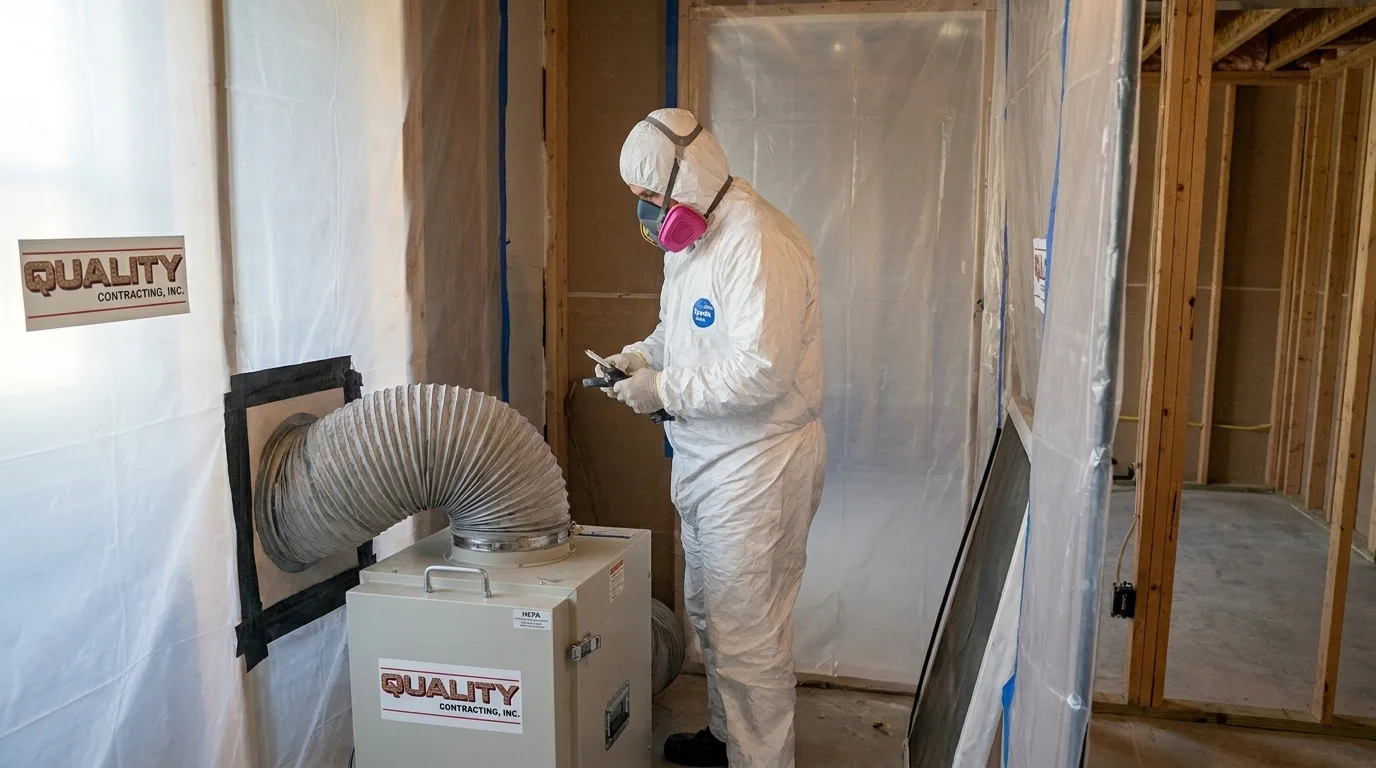
  3. Regulated containment and negative air pressure. The work area is sealed with poly sheeting, critical barriers are taped, and HEPA-filtered negative air machines run continuously to prevent fiber migration to adjacent spaces. Workers wear full Tyvek suits and supplied-air or half-face respirators with P100 cartridges.

  4. Wet removal and waste packaging. ACMs are wetted with amended water (a surfactant solution that suppresses airborne fibers) immediately before and during removal. Waste is double-bagged in 6-mil poly, labeled per EPA and Massachusetts DLS requirements, and staged in a secure area.

  5. Air clearance testing and waste disposal. After cleanup, an independent third-party industrial hygienist conducts final air clearance sampling using phase contrast microscopy (PCM) or transmission electron microscopy (TEM). Only after clearance is confirmed does containment come down. Waste is transported by a licensed hauler to a permitted disposal facility, and the disposal manifest is provided to the property owner.

What separates a good abatement response from a bad one

The most common failure point is skipping or shortcutting the air clearance test. Some contractors remove the poly, declare the job done, and leave — with no independent confirmation that fiber levels are safe. A proper clearance sample, collected and analyzed by a party independent of the abatement contractor, is the only objective evidence the space is safe to reoccupy.

A second common problem is incomplete material identification. Asbestos was used in dozens of building products, and it’s not always where people expect it. Contractors who only test the obvious material — the popcorn ceiling — and miss the mastic under the tile or the joint compound behind the drywall create liability for everyone downstream, including the next contractor who opens that wall.

Insurance adjusters and industrial hygienists reviewing abatement files look for three things: the laboratory chain-of-custody documentation for bulk samples, the DLS notification (where required), and the signed air clearance report. Missing any of these can delay a claim or trigger a re-abatement requirement.

What does asbestos abatement cost?

Typical costs for asbestos abatement vary significantly based on material type, square footage, accessibility, and disposal fees. Most homeowners pay somewhere in the ranges below — these are industry-typical figures, not quotes.

ScenarioTypical range
Single-room popcorn ceiling removal (up to 200 sq ft)$1,500 – $3,000
Full-floor vinyl tile and mastic removal$3,000 – $7,000
Basement pipe and boiler insulation removal$4,000 – $10,000
Whole-house popcorn ceiling (1,500–2,000 sq ft)$8,000 – $15,000
Commercial ceiling tile or fireproofing removal$10,000 – $30,000+
Asbestos inspection and lab sampling only$400 – $900

Every loss and every building is different — Quality Contracting, Inc. provides a written scope of work before any project begins so there are no surprises. Homeowners insurance typically covers asbestos abatement when the ACMs were disturbed by a covered peril (a burst pipe, fire, or storm), but generally does not cover elective removal during a renovation; an adjuster’s determination depends on the specific cause of loss.

Seasonal and regional considerations

Massachusetts’s freeze-thaw cycles are hard on pre-1980 housing stock. Pipes burst in January, and the insulation wrapped around those pipes is often the same chrysotile asbestos wrap installed when the house was built. Water damage and asbestos abatement frequently overlap in Worcester County for exactly this reason — a water loss that disturbs pipe insulation creates a combined remediation scope that needs to be sequenced correctly: asbestos abatement first, then drying and reconstruction.

Older triple-deckers and mill-era homes throughout Auburn, Worcester, Millbury, Shrewsbury, and Grafton were built during the peak asbestos-use period (roughly 1940–1978). If your home dates to that era and hasn’t had a formal asbestos inspection, any renovation project — kitchen remodel, bathroom gut, HVAC replacement — warrants sampling before demolition begins.

Service area

Quality Contracting, Inc. is based in Auburn and serves communities throughout central Massachusetts, including Worcester, Millbury, Shrewsbury, Grafton, Sutton, Oxford, Leicester, and surrounding towns. City-specific pages for each area link back here for full process detail.

If you’ve found suspect material, are planning a renovation in a pre-1980 building, or are dealing with a water or fire loss that may have disturbed insulation or tile, call (508) 756-8800 to schedule an asbestos inspection and get a written scope before any work begins.

Frequently Asked Questions

Does homeowners insurance cover asbestos abatement?
It depends on the cause of disturbance. Homeowners insurance typically covers asbestos abatement when ACMs were disturbed by a covered peril — a burst pipe, fire, or storm damage — but generally excludes elective removal during a planned renovation. Quality Contracting, Inc. works with all major insurance carriers and prepares the documentation adjusters need: bulk sample lab reports, the abatement scope, DLS notification records, and the final air clearance report.
What's the difference between asbestos encapsulation and full removal — and when is each appropriate?
Encapsulation involves coating or sealing ACMs in place so fibers cannot be released, rather than physically removing the material. It's appropriate when the material is in good condition, is not being disturbed by renovation, and will remain undisturbed going forward — for example, intact pipe insulation in a sealed mechanical room. Full removal (abatement) is required when the material is friable (crumbling), has been disturbed by water or impact, or is in the path of planned renovation work. Massachusetts DLS regulations and the specific condition of the material drive that determination.
Can I test for asbestos myself with a home kit, or does it need to be done by a professional?
DIY bulk sample kits are commercially available and use accredited labs, but Massachusetts regulations require that sampling for regulated abatement projects be performed by a licensed asbestos inspector — not a homeowner. Beyond the legal requirement, proper sampling technique matters: samples collected without wetting the material or without sealing the disturbed area immediately can release fibers and may not be representative of the full material. For any project where abatement will follow, a licensed inspection is the correct starting point.
How long after abatement is complete before we can reoccupy the space?
The space should not be reoccupied until the independent air clearance test results confirm fiber levels are within acceptable limits — typically below 0.01 fibers per cubic centimeter under EPA guidance. Clearance sampling is collected after the abatement contractor has finished cleanup and removed gross debris but before containment poly comes down. Lab turnaround on PCM clearance samples is usually same-day or next-day, so reoccupancy is typically possible within 24 hours of abatement completion on smaller projects.
My contractor found popcorn ceiling during a renovation — does work have to stop immediately?
Yes, if there's any reasonable suspicion that the material contains asbestos, work should stop and the area should be left undisturbed until bulk sampling results are back. Massachusetts DLS regulations prohibit renovation work that disturbs ACMs without prior abatement by a licensed contractor. Continuing demolition before testing is complete can spread fibers throughout the structure, significantly increasing the scope and cost of remediation — and creates potential liability for the property owner and the contractor.
Why Choose Us

Looking for the best asbestos abatement company in Auburn?

Quality Contracting, Inc. provides asbestos abatement in Auburn, MA and the surrounding area. We answer calls 24/7 — call (508) 756-8800 for immediate help.

Need Asbestos Abatement now?

We respond 24/7 across Auburn and surrounding MA cities.

Call Now: (508) 756-8800