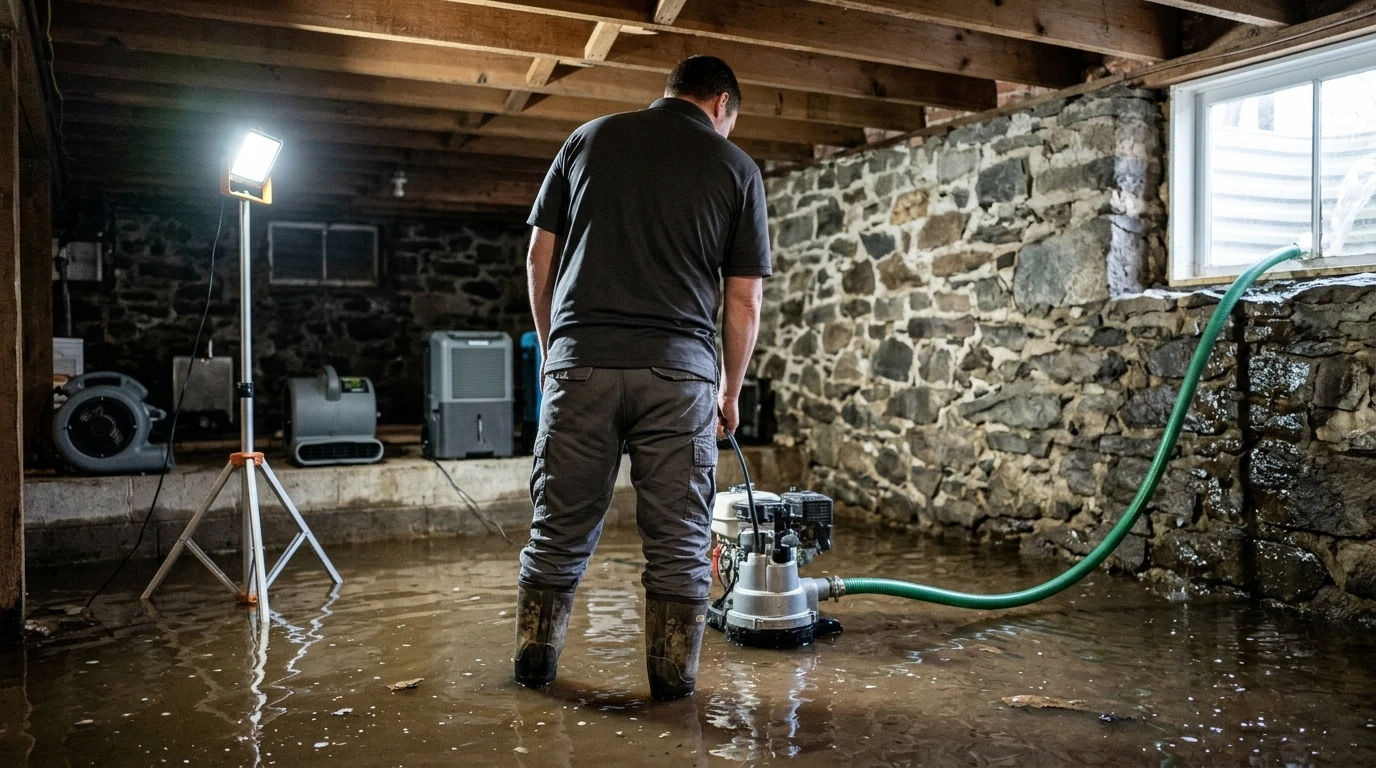
TL;DR: Flooded basement cleanup in Auburn, MA typically costs $1,000 to $3,000 for a small unfinished basement with clean water and no rebuild, and $6,000 to $20,000 or more when a finished basement floods with contaminated water and needs demolition and rebuild. The biggest cost drivers are the water’s contamination level, how many square feet got wet, and whether the space was finished living area or bare concrete.
If you went downstairs this morning and found water across the basement floor, your first question probably isn’t about moisture meters or drying standards. It’s what this is going to cost before you even pick up the phone. Older homes around Auburn and the surrounding Central Massachusetts towns, many built on fieldstone or block foundations, take on groundwater and backup water whenever heavy rain or a fast thaw pushes the water table up. The price swings widely depending on what was down there before the water came in and what kind of water it was. Here’s how those numbers actually break down.
What Does Flooded Basement Cleanup Cost in Auburn, MA?
Flooded basement cleanup in Auburn typically runs $1,000 to $3,000 for a small unfinished space with clean water and no rebuild, and climbs past $10,000 when a finished basement floods with sewage or groundwater and needs full demolition. The table below shows typical ranges by scenario; your actual number depends on square footage, how long the water sat, and what’s behind the walls.
| Scenario | Typical Cost Range |
|---|---|
| Unfinished basement, Category 1 water, extraction and drying only | $1,000 - $3,000 |
| Finished basement, Category 1 water, carpet and pad removed | $3,000 - $6,500 |
| Finished basement, Category 2 water, drywall flood-cut and removed | $6,000 - $12,000 |
| Category 3 sewage backup, full demolition and sanitization | $10,000 - $20,000+ |
| Full basement rebuild after demolition (materials and labor) | $15 - $40 per square foot |
These are typical industry ranges, not a quote for any specific job. A written, itemized estimate from a basement flooding cleanup specialist is the only way to know where your job actually lands.
What Drives the Price: Water Category, Square Footage, and Finished vs. Unfinished?
Three things move the price more than anything else: how contaminated the water was, how many square feet got wet, and whether the basement was finished living space or bare concrete and studs.
Water gets sorted into categories under the ANSI/IICRC S500 standard. Category 1 is clean water, like a burst supply line. Category 2 is gray water with real contamination, such as groundwater seeping in under hydrostatic pressure. Category 3 is grossly contaminated black water, including any sewer backup or rising flood water. Clean water sitting on bare concrete can often be extracted and dried without removing anything; contaminated water almost always means something gets torn out.
Square footage sets the extraction and equipment time. A typical basement needs three to five days of air movers and a dehumidifier running to reach safe moisture levels, longer if the slab or fieldstone walls are holding water, since masonry falls into the slower Class 4 drying category under the S500 standard. More square footage means more equipment and more days of rental and monitoring, which shows up directly in the invoice.
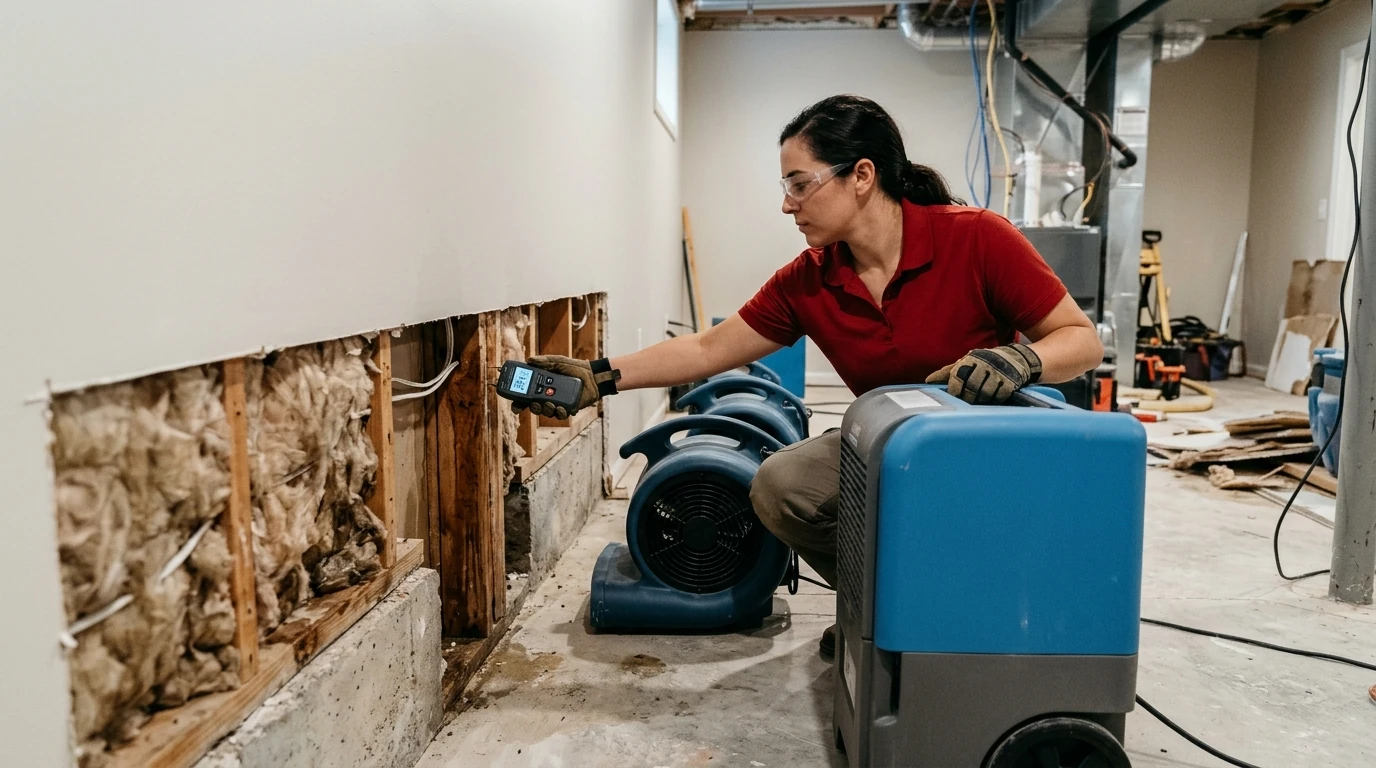
Finished versus unfinished is the biggest single swing. In a finished basement, wet carpet and pad almost always come out, since padding holds water against the subfloor and can’t be dried in place. Drywall gets cut and removed starting about 12 to 24 inches above the waterline, a “flood cut,” whenever the water was Category 2 or 3, because contaminated water wicks upward inside the wall cavity. An unfinished basement with bare concrete skips most of that demolition, which is why the same flood can cost three times as much next door in a finished rec room.
Why Does a Sewage Backup Cost More to Clean Up?
A sewage backup costs more because it’s automatically Category 3 water, which means contaminated porous materials get removed instead of dried, and the crew needs PPE and antimicrobial treatment the job wouldn’t otherwise require.
Any backup from a floor drain, toilet, or sewer line beyond the trap counts as black water, regardless of how it looks. That means carpet, pad, baseboards, and often the lower section of drywall all come out rather than getting dried in place, and the subfloor and framing need disinfection before anything gets rebuilt. Sewage cleanup work also requires respirators and protective suits, which adds labor cost on top of the extra demolition. Skipping that step to save money is how a basement ends up with a hidden odor problem months later.
Does Insurance Cover Flooded Basement Cleanup?
Most homeowners policies cover a flooded basement when the water came from a sudden, accidental source inside the home, like a burst pipe or a failed water heater, but they typically exclude outside flood water and exclude sewer backup or sump pump failure unless you’ve added a water backup endorsement.
Groundwater and surface flooding generally fall under flood insurance, not a standard homeowners policy; that coverage comes through the National Flood Insurance Program or a private flood policy, not your regular carrier. If a backup or a failed sump pump caused the flood, check your declarations page for a water backup endorsement specifically, since it’s the only thing that typically pays for that scenario. Either way, document everything with photos before cleanup starts and keep every receipt; our full guide to homeowners insurance and water damage walks through what adjusters actually ask for.
How Do You Get an Accurate Written Estimate?
An accurate estimate starts with an in-person inspection that measures moisture with a meter, identifies the water category, and maps the affected square footage before anyone names a price.
A solid estimate separates mitigation (extraction, drying, demolition) from rebuild (drywall, flooring, trim) as two line items, since insurance often processes them differently. It should also note the water category in writing, since that single fact determines whether materials get dried or removed. Call QCI Restoration at (508) 756-8800 for a documented basement assessment before you sign anything with a contractor.
Under a One Call Does It All approach, one contractor handles extraction, drying, demolition, mold prevention, and the full rebuild under a single scope, so you’re not coordinating a plumber, a demo crew, and a general contractor across three separate invoices. If drying drags past 48 hours, mold can begin growing on wet materials in that window according to the EPA, which is one more reason the drying and reconstruction phases need to move on one continuous timeline rather than waiting on separate contractors to schedule.
About QCI Restoration
QCI Restoration serves Auburn, MA and the surrounding Central Massachusetts communities, with crews available 24/7 at (508) 756-8800 and a 4.5-star Google rating across 123 reviews. The company’s restoration work covers water, flood, and sewage cleanup through full reconstruction, following a One Call Does It All model so homeowners work with a single point of contact from the first extraction to the last coat of paint.